
Motivation rarely disappears overnight. It fades—one interaction at a time.
When an employee loses motivation, we often assume the problem is salary, workload, or simply a lack of ambition.
But disengagement usually doesn’t happen suddenly.
It builds quietly.
A good idea gets ignored.
Extra effort goes unnoticed.
A manager starts micromanaging.
Priorities keep changing.
Feedback is requested—but nothing happens.
Individually, these incidents may appear small. Repeated over weeks and months, however, they can gradually drain an employee’s enthusiasm, ownership, and willingness to go the extra mile.
By the time an organisation notices the problem, engagement may already have dropped, productivity may have suffered, or a good employee may have started looking for another job.
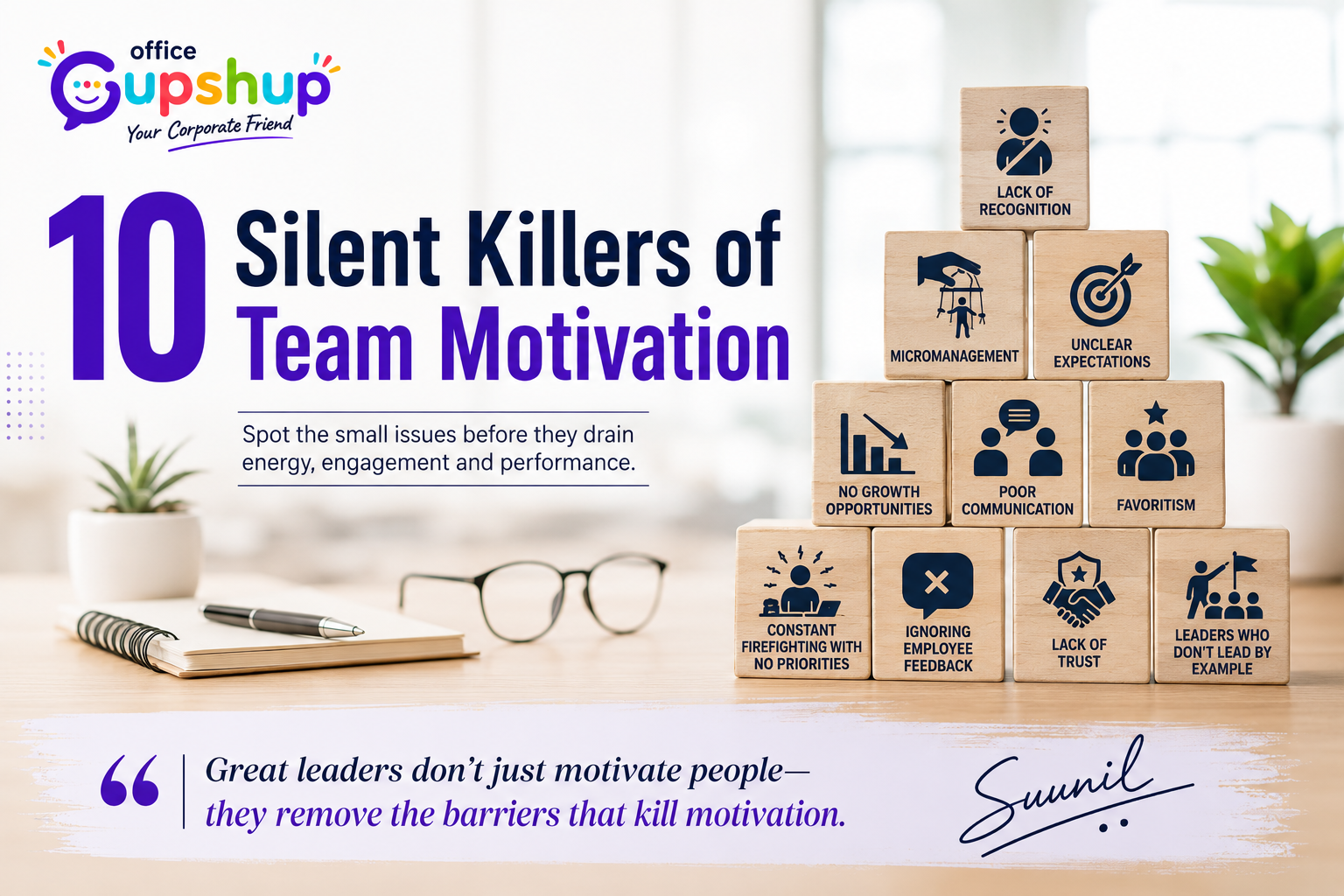
Here are 10 silent killers of team motivation that every manager and leader should watch for.
1. Lack of Recognition
People don’t expect applause for everything they do. But consistently feeling invisible can be deeply demotivating.
When employees put in extra effort, solve difficult problems, support colleagues or deliver excellent work without acknowledgment, they eventually start asking:
“Why am I putting in this extra effort if nobody notices?”
Recognition doesn’t always require bonuses or awards. A genuine “well done,” public appreciation, or acknowledging someone’s contribution in a meeting can have enormous impact.
Good leaders don’t only identify mistakes. They notice effort and progress too.
2. Micromanagement
You hired someone for their ability—then you started telling them how to do every small part of their job.
That’s micromanagement.
Constant checking, excessive approvals, unnecessary involvement and repeatedly asking for updates communicate one damaging message:
“I don’t trust you.”
Employees need accountability, but they also need autonomy.
A good manager defines the destination, establishes expectations and provides support.
They don’t insist on controlling every step of the journey.
3. Unclear Expectations
One of the quickest ways to frustrate employees is to expect results without clearly defining what success looks like.
When priorities aren’t clear, employees spend valuable energy trying to understand:
What exactly is expected from me?
Which task is actually urgent?
How will my performance be measured?
Who makes the final decision?
Clarity creates confidence.
Confusion creates anxiety.
Good leaders ensure employees understand their role, priorities, responsibilities and expected outcomes.
4. No Growth Opportunities
Salary matters.
But so does progress.
Talented employees want to know that the work they’re doing today is helping them become better professionals tomorrow.
When people see no opportunity to learn, take greater responsibility, acquire new skills or advance within the organisation, motivation gradually declines.
And eventually, they may look elsewhere for the growth they cannot find internally.
Sometimes people don’t leave companies because they’re unhappy.
They leave because they can no longer see their future there.
5. Poor Communication
Employees shouldn’t have to rely on office gossip to understand what’s happening in their own organisation.
Poor communication creates uncertainty, rumours and mistrust.
It becomes especially damaging during periods of change.
Leaders don’t need to have every answer. But they should communicate what they know, what they don’t know, what is changing and what employees can expect next.
Silence from leadership rarely creates calm. It creates assumptions.
6. Favouritism
Few things damage team culture faster than employees believing that opportunities depend more on relationships than performance.
When certain people consistently receive better projects, greater visibility, promotions or flexibility without transparent reasons, others notice.
Once employees believe the system isn’t fair, motivation drops quickly.
Leaders don’t have to treat everyone identically.
But they must treat people fairly, consistently and transparently.
7. Constant Firefighting With No Priorities
Everything cannot be urgent.
Yet in some workplaces, everything somehow is.
Employees begin their day with one priority, receive another by lunchtime, and by evening they’re being questioned about why the original task isn’t complete.
Constant firefighting creates activity—not necessarily productivity.
Teams need leaders who can distinguish between what is genuinely urgent and what can wait.
Otherwise employees spend their careers reacting instead of progressing.
8. Ignoring Employee Feedback
Many organisations conduct surveys, town halls and feedback sessions.
The real question is:
What happens afterwards?
Asking employees for feedback and repeatedly doing nothing about it can actually be worse than not asking.
Employees eventually conclude that their opinion doesn’t matter.
Leaders don’t need to implement every suggestion.
But they should acknowledge feedback, explain decisions and communicate what action—if any—will be taken.
If people feel heard, they are far more likely to stay engaged.
9. Lack of Trust
Trust is one of the foundations of a healthy workplace.
When managers constantly question intentions, monitor employees unnecessarily, withhold information or assume the worst, people become defensive.
And when employees don’t trust leadership, they stop speaking openly.
Ideas disappear.
Problems get hidden.
People play safe.
Innovation suffers.
Trust doesn’t mean eliminating accountability. It means creating an environment where people can take responsibility without constantly protecting themselves.
10. Leaders Who Don’t Lead by Example
Perhaps the most damaging motivation killer is hypocrisy.
A manager demands punctuality but regularly arrives late.
A leader talks about work-life balance but sends non-urgent messages at midnight.
Management asks employees to reduce costs while leadership spends extravagantly.
A company talks about respect while senior leaders behave disrespectfully.
Employees pay far more attention to what leaders do than what leaders say.
Leadership isn’t demonstrated through presentations or motivational speeches.
It’s demonstrated through behaviour.
The Real Cost of Demotivation
The dangerous part about declining motivation is that it doesn’t always look dramatic.
People may continue coming to work.
They attend meetings.
They complete assigned tasks.
They answer emails.
But something changes.
They stop suggesting ideas.
They stop volunteering.
They stop challenging bad decisions.
They do exactly what is required—and nothing more.
This is sometimes called discretionary effort: the additional energy people willingly contribute when they feel engaged and valued.
When motivation disappears, that extra effort often disappears with it.
And eventually, the organisation pays the price through lower productivity, weaker innovation, absenteeism, disengagement and attrition.
Before Calling Someone “Unmotivated,” Ask a Different Question
Managers sometimes ask:
“How do I motivate my team?”
Perhaps the better question is:
“What are we doing that may be demotivating them?”
You cannot motivate every person every day.
But you can create an environment where motivated people aren’t gradually drained by unnecessary organisational problems.
Sometimes leadership isn’t about adding another incentive.
It’s about removing the barriers that make people stop caring.
A Quick Check for Managers
Think about your own team and ask yourself:
- Do good contributions receive recognition?
- Do people have enough autonomy to do their jobs?
- Are expectations and priorities genuinely clear?
- Can employees see opportunities to grow?
- Do we communicate openly, especially during uncertainty?
- Are opportunities distributed fairly?
- Do we distinguish priorities from everyday noise?
- When employees give feedback, do we respond?
- Do people feel trusted?
- Do leaders follow the standards they expect from everyone else?
If several answers make you uncomfortable, that itself may be useful feedback.
Final Thoughts
Great workplaces aren’t created by motivational speeches, annual awards or occasional team outings.
They’re created through hundreds of everyday interactions between employees and leaders.
A little recognition.
A little trust.
Clear expectations.
Fair treatment.
An opportunity to grow.
And leaders whose actions match their words.
At Office Gupshup, we believe workplace problems often become serious because the small warning signs are ignored for too long.
So before asking employees to become more motivated, perhaps every leader should ask:
“Are we creating an environment where people can remain motivated?”
Because great leaders don’t just motivate people.
They remove the barriers that kill motivation.