
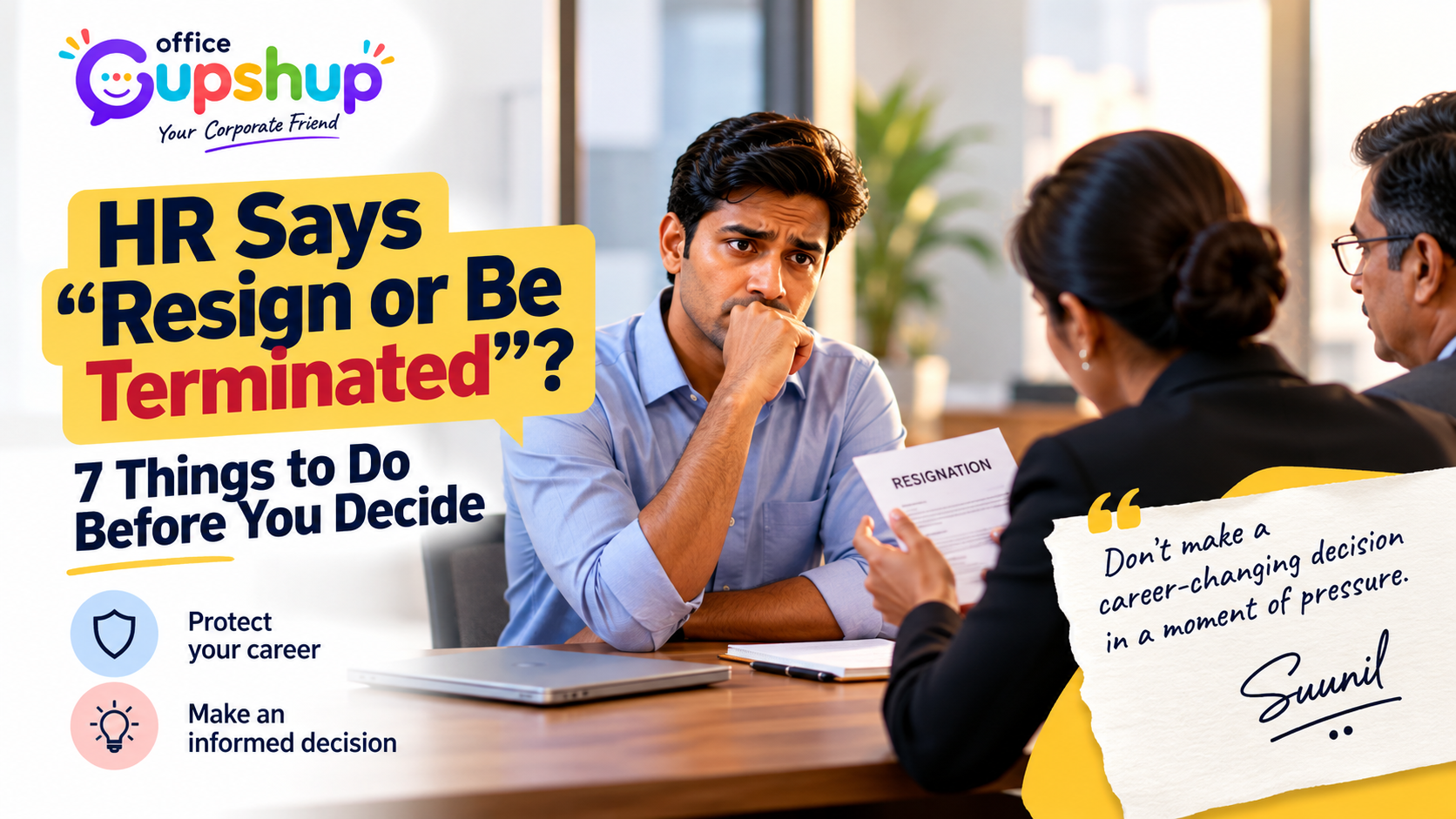
Your manager calls you into a meeting.
HR is already sitting there.
You assume it is about your performance, a project, or perhaps some organisational changes.
After a few minutes, HR says:
“We think it would be better if you resigned voluntarily. Otherwise, we may have to terminate your employment.”
You weren’t planning to resign.
You haven’t accepted another job.
You have rent or EMIs to pay. Perhaps your parents depend on your salary. Perhaps you have a family to support.
And now, someone is asking you to make a decision that could change your career.
Today.
Your mind starts racing.
If I refuse to resign, will they fire me?
Will termination spoil my career?
Will another company reject me during background verification?
Will I lose my notice pay or full-and-final settlement?
Should I just sign the resignation letter and get out of this uncomfortable meeting?
If you’re facing something similar, here’s the first thing to understand:
You do not have to treat HR’s preferred option as automatically being your best option.
Equally, refusing to resign does not guarantee that your job will be saved.
What matters is understanding why the company wants you to leave, what exactly it is proposing, and what the consequences of your decision could be.
Let’s talk about how to handle this situation calmly and professionally.
Why Would a Company Ask You to Resign Instead of Terminating You?
This is probably the first question running through your mind.
If the company no longer wants me, why doesn’t it simply terminate my employment?
There can be several explanations.
Sometimes an organisation is restructuring and wants employees to leave through a mutually agreed separation.
Sometimes there are performance concerns and management believes the employment relationship is unlikely to improve.
Sometimes the employer wants to avoid a lengthy internal process or negotiate an exit.
And in some situations, an employee may be pressured into submitting what appears to be a voluntary resignation, even though leaving was never their choice.
These situations are not identical.
A genuine negotiated separation can sometimes benefit both parties. A resignation obtained through improper pressure raises very different questions.
The important thing is not to assume that every HR conversation is illegal or that every employer is acting fairly.
Start by understanding the facts, not guessing the intentions.
If your situation began with a Performance Improvement Plan, our earlier guide on what to do when you’re put on a PIP at work explains how to assess performance concerns before deciding whether to stay or leave.
But when HR explicitly asks you to resign, the conversation has moved beyond ordinary performance feedback.
You now need to understand the proposed separation.
1. Don’t Submit Your Resignation Just to End an Uncomfortable Meeting
Imagine sitting across from two senior people.
Your manager looks serious.
HR says the company has made its decision.
Then comes the sentence:
“We need your resignation email before the end of the day.”
It’s natural to feel frightened.
You might think:
If I cooperate, at least they’ll give me a good relieving letter.
Or:
Maybe resigning will look better than being terminated.
Possibly. But you don’t yet know what the company is actually offering.
A resignation is not just another email.
It may become an important part of your employment record and can affect how your departure is characterised.
So avoid sending one merely because you want the meeting to end.
Instead, you could say:
“I understand the company’s position. Since this decision was unexpected, I would like to review the reasons and proposed separation terms before responding.”
Notice what you’re doing.
You’re not shouting.
You’re not threatening anyone.
You’re not refusing to cooperate with legitimate company procedures.
You’re asking for information before making a serious decision.
If HR insists that you respond immediately, ask whether the deadline can be extended and request that the proposed terms be shared in writing.
There is no universal legal entitlement to a cooling-off period in every employment situation. But requesting reasonable time is a sensible first step.
A professional response does not require an immediate yes.
2. Ask HR One Important Question: “Why Am I Being Asked to Leave?”
Don’t settle for vague explanations.
For example:
“Management has decided.”
Or:
“You’re not fitting into the organisation.”
Or:
“This is in everyone’s best interest.”
These statements don’t explain much.
Ask for clarity.
Is the company eliminating your position?
Is the issue related to documented performance concerns?
Is there an allegation of misconduct?
Is the organisation proposing a mutually agreed separation?
Or is HR simply recommending that you resign?
The distinction matters because the process, documentation, possible payments and legal considerations can differ.
Consider two situations.
Situation A:
A company closes a business division and offers affected employees a documented separation package.
Situation B:
An employee is suddenly told to resign because the manager is unhappy, without any clear explanation of the proposed exit.
Both employees may hear the words “please resign.”
But the underlying circumstances are very different.
Ask HR:
“Could you please clarify whether this is a company-initiated separation proposal, a performance-related decision, or a request for voluntary resignation?”
You may not receive every answer immediately.
But the question helps establish what you need to understand.
3. Ask for the Separation Terms in Writing
Here’s a common mistake.
An employee spends the entire HR meeting worrying about whether the next employer will discover the termination.
Meanwhile, nobody discusses the financial terms of leaving.
Before making a decision, try to understand:
- Your proposed last working day.
- Whether you are expected to serve notice or leave immediately.
- Whether notice pay or payment in lieu of notice is proposed.
- Salary and other amounts outstanding.
- Any applicable leave encashment.
- Eligibility for gratuity and other statutory dues.
- Pending incentives, commissions or variable compensation.
- Whether any additional severance or ex gratia payment is being offered.
- The wording and process for relieving and experience letters.
- Whether you are being asked to sign a full-and-final settlement or release of claims.
Don’t assume that every employee is entitled to the same severance amount.
India’s employment rules can vary depending on the employee’s legal classification, employment terms, applicable legislation, establishment and circumstances of separation.
The four labour codes, effective from 21 November 2025, also make it important to distinguish statutory entitlements from contractual benefits and negotiated separation payments.
You can review official information through the Ministry of Labour and Employment and the Maharashtra Labour Department, where relevant.
For an actual dispute, obtain advice from a qualified employment-law professional rather than relying on a general internet article.
And remember:
A company’s willingness to issue a relieving letter is not, by itself, proof that the overall separation proposal is fair.
4. Understand What Resignation or Termination Could Mean for Your Next Job
This is where many employees become especially anxious.
What will I tell the next HR?
What if the background verification company calls my previous employer?
Will they find out I was terminated?
Let’s separate the fear from the facts.
Does termination automatically ruin your career?
No.
People lose jobs for many reasons, including restructuring, redundancy, business closures, performance disagreements and misconduct allegations.
These circumstances are not interchangeable.
What matters to a future employer may include the reason for departure, the accuracy of your explanation, your employment record and the requirements of the new role.
Is resignation always better for background verification?
Not necessarily.
A resignation letter does not guarantee that your previous employer will describe the separation in exactly the same way.
And a negotiated exit does not automatically mean that every future verification question will be answered favourably.
Before agreeing to leave, ask HR:
“How will my reason for separation be recorded, and what employment information will the company ordinarily confirm during background verification?”
Also ask what documentation you will receive.
Avoid requesting false records or giving misleading explanations to future employers.
You want an accurate, professional account of what happened.
If you’re considering searching for another job while the situation is unresolved, read our guide on whether you should tell your boss you’re interviewing elsewhere.
Protecting your next opportunity matters just as much as managing your current exit.
5. Keep Records, but Don’t Turn the Situation Into a Personal War
After an unexpected HR meeting, emotions can run high.
You may want to send an angry email.
You may want to post about the company on LinkedIn.
Or you may be tempted to forward confidential company documents to your personal email as evidence.
Be careful.
Instead, create an accurate personal timeline of what happened.
Record the date, time, participants, statements you recall, documents discussed and deadlines communicated.
Preserve your own employment documents and communications that you are lawfully entitled to retain.
Do not improperly copy confidential business data, customer information, trade secrets or other employees’ personal information.
Where appropriate, send a calm follow-up email.
Example:
Subject: Clarification Regarding Today’s HR Discussion
“Dear [HR Name],
Thank you for meeting with me today.
My understanding is that the company has proposed that I submit my resignation, with termination mentioned as a possible alternative.
As this was unexpected, I would appreciate written clarification of the reasons for the proposed separation, the applicable terms, my last working day, and the documents and payments involved.
I would also appreciate reasonable time to review the information before communicating my decision.
Regards,
[Your Name]”
This email is not an accusation.
It simply records your understanding and requests clarification.
If the discussion involved disputed allegations, threats or possible unlawful conduct, seek legal guidance promptly about how to document and respond.
And if you believe your manager has been repeatedly intimidating or humiliating you, our article on what to do when your boss keeps shouting at you may help you separate a difficult management relationship from the formal employment decision now facing you.
6. Decide Whether to Negotiate, Challenge or Prepare Your Exit
Once you understand the situation, you may have several possible paths.
There is no single correct choice for everyone.
Option A: Explore a negotiated separation
If the company genuinely intends to end the employment relationship, a documented and fair separation arrangement may sometimes be worth considering.
You could discuss the last working day, applicable payments, handover responsibilities, documentation and practical transition arrangements.
Don’t assume that a proposed package is automatically the final offer.
But don’t assume the employer is obliged to agree to your requested terms either.
Option B: Dispute inaccurate allegations
Suppose HR says your performance has been consistently poor.
But your recent appraisal, emails and performance records tell a different story.
You can ask for the concerns to be explained and respond with relevant facts.
A professional disagreement might sound like:
“I understand the concern raised, but I would like to review the supporting details because my previous performance discussions reflected a different assessment.”
If there are serious allegations or potential legal consequences, independent advice becomes particularly important.
Option C: Seek qualified legal advice
If you believe you are being coerced, discriminated against, retaliated against, or denied contractual or statutory entitlements, consult an employment-law professional.
Indian courts have considered whether resignations were genuinely voluntary or allegedly obtained under pressure. However, proving coercion depends on the particular facts and evidence. Feeling that you had limited career choices does not automatically establish that a resignation was legally forced.
Do not assume that writing “under protest” in an email automatically protects every right or that you can always withdraw a resignation later.
Option D: Prepare for your next opportunity
Even while discussing your present employment, begin assessing your financial position and career alternatives.
Update your résumé.
Reconnect with professional contacts.
Research relevant roles.
Understand your notice-period commitments.
And calculate how long your savings could support you if there is a gap between jobs.
If the separation becomes final, our guide on what to do in the first 24 hours after a layoff offers a practical starting point for organising the next phase.
Not every forced-resignation dispute is a layoff, but some of the immediate career-planning steps remain useful.
7. Before Deciding, Take the Office Gupshup PAUSE Test
When HR is asking for an answer and your mind is full of questions, you need a simple way to organise your thinking.
That’s why we recommend the Office Gupshup PAUSE Test.
P — Pause
Am I making this decision because I understand the situation, or simply because I feel frightened, embarrassed or pressured?
A decision made to escape an uncomfortable conversation may not be the decision you would make after reviewing the facts.
A — Ask
Have I asked why the company wants me to leave?
Do I understand whether this is restructuring, performance-related, misconduct-related or a negotiated separation?
Have I requested clarification in writing?
U — Understand
Do I understand what each proposed option could mean?
What will the employment record say?
What documents will I receive?
What are the possible implications for my next job?
S — Settlement
Have I reviewed the proposed payments, notice arrangements, outstanding dues and any additional compensation?
Am I being asked to sign a document that waives or settles claims?
Have I obtained qualified advice where necessary?
E — Evaluate
What is my realistic next step?
Can I negotiate?
Do I have grounds to dispute the proposal?
How long can I manage financially without a salary?
Would an agreed separation help me move forward, or am I being asked to accept terms I don’t understand?
The PAUSE Test cannot decide for you.
But it can help you avoid deciding blindly.
The objective is not always to stay. It is to make an informed decision about how you leave, stay or respond.
What If You’ve Already Sent the Resignation Email?
Perhaps you’re reading this after the meeting.
You panicked.
HR asked you to send a resignation email.
You sent it.
And now you’re wondering whether you made a mistake.
Don’t assume that everything can automatically be reversed.
But don’t assume there is nothing left to examine either.
Start by identifying exactly what you submitted, when it was submitted, whether it was accepted, what the applicable employment terms say and what communications preceded it.
If you believe the resignation was obtained through improper pressure, seek qualified legal advice promptly. The possibility of withdrawing or challenging a resignation depends on the circumstances and applicable rules.
Avoid sending multiple emotional emails without understanding the implications.
And don’t sign additional separation documents merely because you’ve already sent one email.
Review each document on its own terms.
Five Questions Employees Commonly Ask
1. Can HR force me to resign in India?
A genuinely voluntary resignation and an employer-initiated termination are different actions. A resignation allegedly obtained through coercion may be open to legal challenge, but the outcome depends on evidence and applicable law.
2. What if HR says I must resign today?
Ask for the proposed reasons and terms in writing and request time to review them. If you are threatened or believe your rights are being violated, seek legal advice promptly. Don’t assume you have an unlimited right to delay the employer’s process.
3. Will I receive notice pay if I resign?
That depends on the employment contract, applicable law and the circumstances of separation. Resignation, termination, retrenchment and negotiated separation may have different consequences. Ask HR for a written breakdown rather than assuming an amount.
4. Will termination affect my next job?
It can raise questions during hiring or background verification, but termination does not automatically make someone unemployable. The reason for separation, available records and your accurate explanation matter.
5. Should I resign or wait for the company to terminate me?
There is no universal answer. Compare the documented terms, legal considerations, financial consequences and future employment implications before deciding. Where the stakes are serious, obtain independent professional advice.
One Final Thought: Your Job and Your Career Are Not the Same Thing
Losing a job can be frightening.
Especially when you didn’t see it coming.
You may feel rejected.
You may feel angry.
You may wonder what you will tell your family.
Or you may keep replaying the HR conversation in your mind, thinking of everything you should have said differently.
But remember something important.
An employer can make a decision about your role. That decision does not define your entire professional worth.
You still have experience.
You still have skills.
You still have relationships, knowledge and opportunities to build.
The way you handle this moment can influence what happens next.
So don’t turn one difficult meeting into an unnecessarily damaging decision.
Ask questions.
Understand your options.
Protect your legitimate interests.
Seek appropriate advice.
And plan your next move with clarity.
Sometimes that will mean negotiating an exit.
Sometimes it will mean challenging a decision.
And sometimes it will mean accepting that the employment relationship has ended and focusing your energy on what comes next.
Whatever the outcome, try to make the decision with information rather than fear.
HR Has Asked You to Resign, and You Don’t Know What to Do Next?
Maybe you’re wondering whether to send that resignation email.
Maybe you’re worried about your next interview.
Maybe you’re unsure how to speak to HR without making the situation worse.
Or perhaps you simply need someone experienced to listen to what happened and help you organise your thoughts.
That’s where Office Gupshup can help.
Talk to Dr Suunil — Your Corporate Friend.
Book a FREE 10–15 minute introductory chat to discuss your workplace situation, clarify your career questions and consider practical next steps.
No pressure. No selling. Just an honest conversation about what you’re facing.
Book Your FREE Chat With Dr Suunil
You don’t need to have all the answers before the conversation.
Sometimes you just need a better understanding of the questions to ask.
Office Gupshup — Your First Corporate Friend.
Important disclaimer: This article provides general workplace and career information for readers in India. It is not personalised legal advice. Employment rights and obligations depend on applicable laws, contracts and individual circumstances. Office Gupshup provides workplace mentoring, not legal representation. For employment disputes or questions about legal entitlements, consult a qualified professional.