
Money is often discussed in terms of how much we earn, where we invest, and how quickly we can grow our wealth.
But there is another side to financial well-being that receives far less attention:
Learning how much is enough.
As our income increases, our expenses often increase with it. A better phone, a bigger car, premium subscriptions, frequent shopping, expensive holidays—the definition of “normal” keeps changing.
This is where financial minimalism can make a difference.
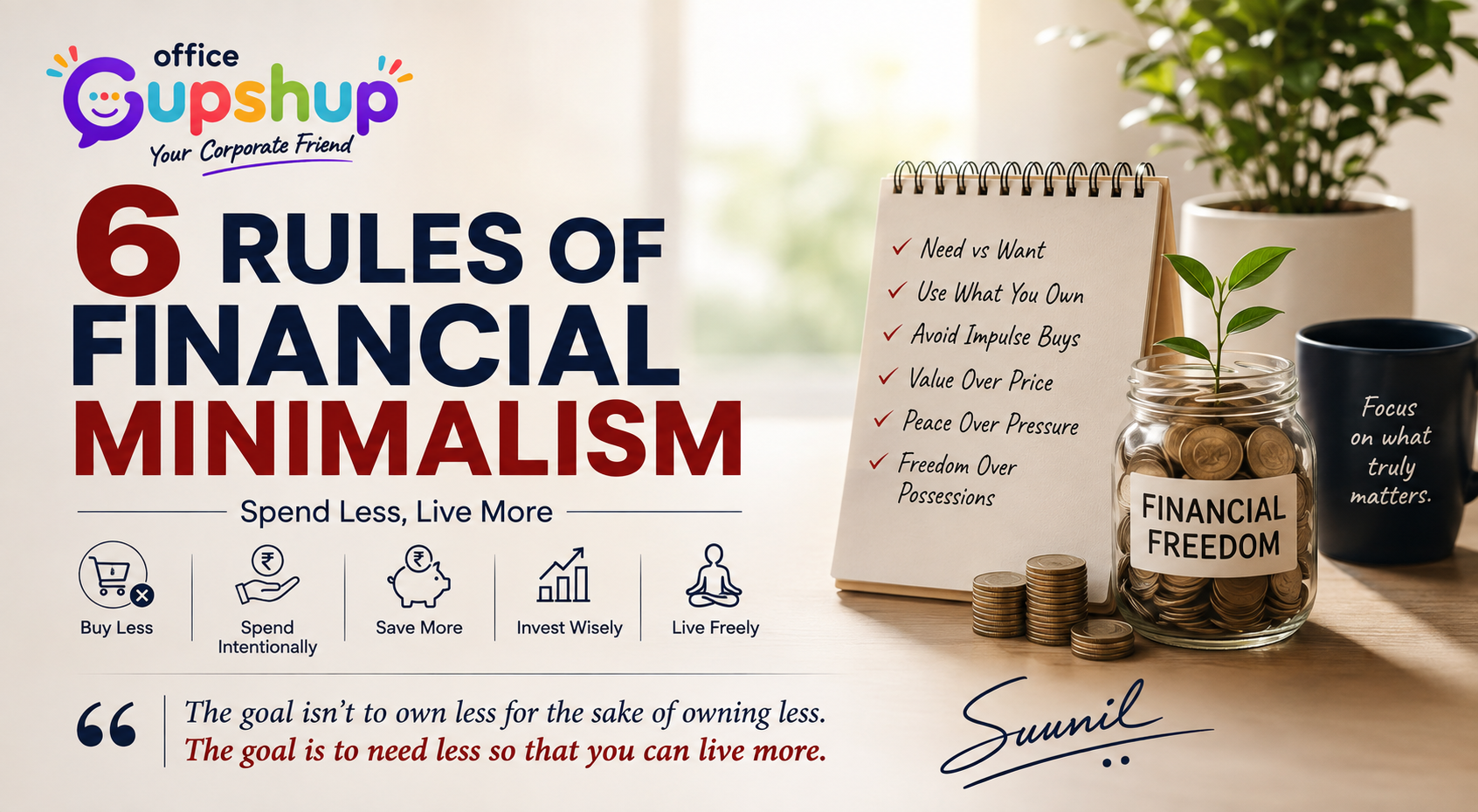
Financial minimalism isn’t about being miserly or depriving yourself of things you enjoy. It is about becoming more intentional with money—spending on things that genuinely add value to your life and eliminating those that don’t.
Here are six simple rules that can change the way you look at spending.
1. If You Don’t Need It, Don’t Buy It
Sounds obvious. Yet this may be the hardest rule to follow.
Sales, discounts, limited-time offers and social media constantly create a sense of urgency.
We often don’t buy because we need something. We buy because:
- It’s on sale.
- Someone else has it.
- We think we deserve a reward.
- Buying gives us temporary excitement.
- We’re afraid of missing out.
Before purchasing something, ask yourself:
“Would I still want this if there were no discount?”
A ₹10,000 product available for ₹7,000 hasn’t necessarily saved you ₹3,000.
If you didn’t need it in the first place, you spent ₹7,000.
2. If You Own It, Use It
Look around your home.
How many clothes haven’t been worn for months? How many gadgets are lying unused? How many subscriptions are automatically renewed but rarely opened?
Money spent on something that provides no utility becomes financial clutter.
Before buying something new, look at what you already own.
Use it.
Repair it.
Finish it.
Reuse it.
Sometimes the easiest way to save money isn’t finding a cheaper alternative.
It’s using what you’ve already paid for.
3. If You Can’t Explain Why You Bought It, Question Whether You Should Keep It
Every purchase should ideally have a purpose.
That doesn’t mean everything must generate money or be strictly necessary. Experiences, hobbies and occasional luxuries can absolutely add value to life.
But there should be an answer to one simple question:
“Why did I buy this?”
If the answer is unclear—or the item no longer serves the purpose for which you bought it—consider selling, donating or removing it.
Financial minimalism isn’t merely about buying less.
It’s also about owning intentionally.
4. If You Wouldn’t Buy It Twice, Think Carefully Before Buying It Once
This is an interesting test for impulse purchases.
Before spending ₹5,000 on something, imagine it costs ₹10,000.
Would you still want it?
The idea isn’t that you should literally buy two of everything. The question forces you to evaluate how strongly you value the purchase.
It separates:
“I really want this.”
from
“It would be nice to have.”
That small pause can prevent a surprising amount of unnecessary spending.
5. If It Doesn’t Bring Peace, It May Be Too Expensive
Not every cost appears on your bank statement.
Some purchases come with EMIs.
Some require maintenance.
Some create anxiety.
Some force us to continue working at a pace we no longer enjoy simply because our lifestyle has become expensive to maintain.
A bigger house, premium car or luxury purchase may be affordable according to your salary—but ask another question:
What does it cost you in peace of mind?
If maintaining your lifestyle constantly makes you anxious about your next salary, bonus or EMI, the real cost may be much higher than the purchase price.
Financial success should ideally create more freedom, not more pressure.
6. The Less You Need to Spend, the Faster You Become Financially Free
This is perhaps the most powerful principle of financial minimalism.
Financial freedom isn’t determined only by how much money you accumulate.
It is also influenced by how much money you need to maintain your lifestyle.
Imagine two professionals.
One earns ₹2 lakh per month and spends ₹1.90 lakh.
Another earns ₹1.25 lakh and spends ₹70,000.
Who is financially stronger?
Income alone doesn’t answer the question.
The gap between what you earn and what you spend creates the capacity to save, invest and build financial security.
Every permanent increase in lifestyle expenses raises the amount of money required to sustain that lifestyle.
Every unnecessary recurring expense you eliminate gives you a little more freedom.
The Lifestyle Inflation Trap
One of the biggest financial challenges for working professionals is lifestyle inflation.
You get promoted.
Your salary increases.
And almost immediately:
The car gets upgraded.
The holidays become more expensive.
Dining becomes more frequent.
Subscriptions multiply.
Shopping increases.
Five years later, your salary may have doubled—but strangely, you still feel financially stretched.
Career growth should ideally increase your financial security.
Instead, for many professionals, it simply upgrades their expenses.
There’s nothing wrong with enjoying the rewards of your hard work.
The key is ensuring that your wealth grows along with your lifestyle.
Financial Minimalism Doesn’t Mean Living Cheaply
This distinction is important.
Financial minimalism isn’t about choosing the cheapest option every time.
Sometimes buying a high-quality product that lasts ten years is better than repeatedly buying cheaper alternatives.
Sometimes spending money on travel, family, health, education or experiences provides enormous value.
The philosophy is simply:
Spend generously on what genuinely matters to you. Cut ruthlessly what doesn’t.
That creates a lifestyle based on priorities rather than appearances.
A Simple Rule Before Your Next Purchase
Before making a non-essential purchase, ask yourself three questions:
Do I need it?
Will I actually use it?
Does buying it move me closer to or further away from my financial goals?
You won’t always decide against buying it—and that’s perfectly fine.
The objective isn’t to stop spending.
The objective is to stop spending unconsciously.
Final Thoughts
Financial freedom isn’t necessarily about becoming extremely wealthy.
Sometimes it’s simply reaching a point where money stops controlling your decisions.
You don’t need every upgrade.
You don’t need to match someone else’s lifestyle.
And you certainly don’t need to prove your success through what you own.
Earn well.
Spend consciously.
Invest consistently.
And allow the difference between what you earn and what you need to gradually buy something far more valuable than another possession:
Freedom.
At Office Gupshup, we believe career growth and financial well-being should go together. A bigger salary is valuable—but learning how to manage the lifestyle that comes with it can be even more important.
The goal isn’t to own less for the sake of owning less. The goal is to need less so that you can live more.