
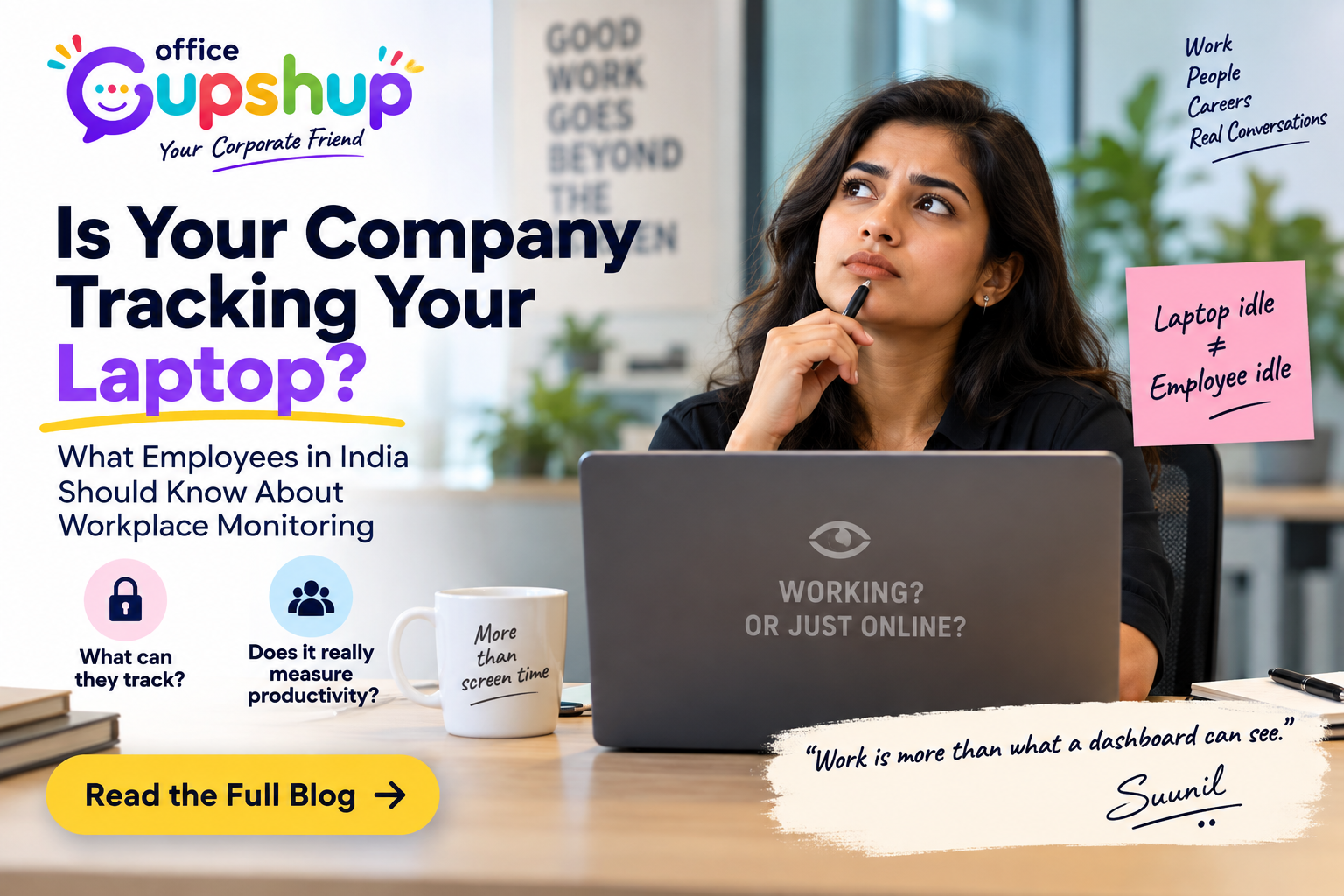
Imagine being told your job is at risk because your laptop showed just 14 minutes of inactivity.
That is the claim behind a workplace story going viral.
An employee reportedly said that an AI-powered productivity system recorded 14 minutes during which she appeared inactive on her computer. According to her account, she wasn’t taking a break.
She was helping a client.
Her laptop wasn’t active.
She was.
Whether or not one viral workplace story tells us the whole picture, it raises a question that is becoming increasingly relevant for employees:
Can software really measure whether you’re working — or can it only measure what you’re doing on your computer?
Think about a normal day at work.
You could be speaking to a client on your phone.
Sitting with a colleague to solve a problem.
Reading a printed agreement.
Attending a discussion away from your desk.
Writing notes.
Or simply spending ten quiet minutes thinking through a difficult problem.
Your laptop may show little or no activity during any of these situations.
But does that mean you’re not working?
Welcome to one of the newest workplace dilemmas:
When companies can measure more and more of our digital activity, how do we make sure activity isn’t confused with productivity?
Let’s Gupshup.
Can Your Company Track Your Work Laptop?
If you’re using a company-issued laptop, you should generally understand that some work-related activity may be logged or monitored, depending on your employer’s systems, policies and the technology being used.
That could potentially include things such as:
- login and logout information,
- access to company systems,
- applications being used,
- corporate network activity,
- security events,
- time spent on certain work applications,
- attendance-related information, and
- periods where the system records little or no digital activity.
But here’s an important distinction:
“My company monitors its devices” does not automatically mean “my boss is secretly watching everything I do.”
Different tools collect different information for different reasons.
Some may exist primarily for cybersecurity.
Some may help with attendance.
Some may measure application usage.
Others may be designed to understand utilisation or productivity.
So before panicking, ask a much better question:
What exactly is being measured, who can see it, and how is that information being used?
Why Is Employee Monitoring Suddenly Such a Big Workplace Issue?
Because work itself has changed.
For decades, physical presence was one of the easiest things for companies to observe.
You entered the office.
Your manager saw you.
You sat at your desk.
You attended meetings.
You left in the evening.
Remote and hybrid work changed that visibility.
At the same time, almost every part of modern office work became digital.
Emails.
Teams calls.
CRM systems.
ERP applications.
Project-management software.
Cloud documents.
Login records.
Company laptops.
That means workplaces now generate enormous amounts of digital information.
And technology can increasingly turn that information into dashboards, scores and patterns.
That may help organisations understand how work happens.
But it creates another danger:
What is easy to measure can start looking more important than what is difficult to measure.
And good work isn’t always easy to measure.
Activity Is Not the Same as Productivity
Consider two employees.
Employee A
Laptop active for nine hours.
Emails open.
Excel open.
Teams open.
Plenty of keyboard and mouse activity.
Employee B
Laptop active for seven hours.
But during the day, Employee B:
- solves an important customer problem,
- finishes a critical presentation,
- helps a junior colleague,
- catches an error before it reaches a client, and
- completes every important deliverable.
Who had the more productive day?
A laptop-activity number alone cannot answer that.
This connects with something we discussed in 9 Workplace Truths Your Boss May Never Tell You — But You Should Know:
Hard work, visibility and actual career value are related — but they are not always the same thing.
A dashboard can be excellent at counting activity.
Understanding value is much harder.
Your Laptop Is Idle. Are You?
Imagine you’re in sales.
A major client calls your mobile phone and you spend 35 minutes resolving an issue.
Your laptop is untouched.
Now imagine you’re in finance.
You spend 20 minutes reading a physical agreement before approving an important transaction.
Laptop untouched.
Or you’re a manager.
A team member comes to you with a problem and you spend half an hour helping them work through it.
Again:
Laptop untouched.
In all three situations, the computer may show inactivity.
But productive work is happening.
That’s why digital activity should be treated as data, not automatically as a verdict.
The number may be correct.
The interpretation may still need context.
What If Your Manager Says, “Your Productivity Is Low”?
This is where the topic stops being theoretical.
Imagine your manager calls you into a meeting and says:
“Your active hours are lower than the rest of the team.”
What do you do?
First, don’t immediately become defensive.
And don’t start with:
“This software is rubbish.”
Even if you believe the measurement is unfair, attacking the system probably won’t help your conversation.
Instead, ask calmly:
“Can you help me understand which productivity measures are causing concern?”
Then clarify:
“Is this based mainly on laptop activity, or are my deliverables, meetings, client interactions and outcomes also being considered?”
If there are genuine periods where your digital activity doesn’t reflect your work, explain them.
For example:
“There may be periods where my laptop shows limited activity because I was handling client calls and discussions away from my desk. Can we look at those periods alongside my actual deliverables?”
You’re not fighting the dashboard.
You’re adding information the dashboard may not have.
How you communicate in these conversations matters. Our guide on How to Deal With Office Politics in an Indian Workplace Without Becoming Political Yourself discusses a related workplace skill: staying factual, building visibility and documenting important work without becoming confrontational or political.
Start Keeping Your Own “Proof of Work”
This doesn’t mean taking screenshots every five minutes.
And it certainly doesn’t mean becoming paranoid.
It means developing one very useful professional habit:
Keep track of what you actually accomplish.
At the end of each week or month, make a simple note of:
- important projects completed,
- problems solved,
- deadlines met,
- client conversations that mattered,
- revenue generated or costs saved,
- processes improved,
- additional responsibilities handled,
- positive feedback received,
- major errors prevented, and
- work performed away from your computer.
This habit is useful even if your company never installs a productivity-monitoring tool.
Why?
Because appraisal season eventually arrives.
And when your manager asks:
“What were your major contributions this year?”
there’s a huge difference between saying:
“I worked really hard.”
and saying:
“Here are the seven things I delivered and the impact they created.”
Your effort matters.
But your ability to explain the outcome of that effort matters too.
Don’t Try to Fool the Monitoring Software
Whenever employee-monitoring technology becomes a talking point, another kind of content appears online:
How to keep your laptop looking active.
How to simulate mouse movement.
How to prevent an idle status.
How to trick productivity software.
That’s the wrong battle.
If your organisation has a legitimate monitoring or security system, deliberately trying to defeat it could create a much bigger problem than an inactivity report.
More importantly, ask yourself:
Do you really want your career strategy to become “How do I make software think I’m working?”
Your objective should be:
“How do I make sure the work I’m actually doing is understood?”
Those are completely different mindsets.
Could Laptop Monitoring Affect Your Performance Appraisal?
Potentially — depending on how your organisation uses the information.
But if someone tells you that your productivity is poor because of one metric, ask what else forms part of your performance assessment.
Depending on the role, meaningful performance may include:
- quality of work,
- achievement of targets,
- client outcomes,
- deadlines,
- problem-solving,
- collaboration,
- ownership,
- accuracy,
- revenue,
- cost savings,
- leadership,
- behaviour, and
- role-specific KPIs.
A digital activity metric may be one piece of information.
It should not automatically become the entire story of your performance.
This is also why career visibility matters.
If you’re consistently doing good work but nobody understands what you’re contributing, you may have a broader visibility problem.
Our article How to Network at Work Without Feeling Fake, Awkward or Like a “Chamcha” explains why professional visibility doesn’t have to mean flattery, politics or self-promotion.
Sometimes it simply means making sure the right people understand the value you’re creating.
What If the Dashboard and Your Manager Both Say You’re Underperforming?
Here’s the uncomfortable part.
Don’t automatically assume the technology is wrong.
Sometimes the data may be pointing towards a genuine problem.
Perhaps deadlines are slipping.
Maybe your response times have deteriorated.
Perhaps you’re spending too much time on low-value work.
Or your output really has fallen.
The right response isn’t:
“The system doesn’t understand me.”
It’s:
“What evidence would tell me whether there is actually a performance problem?”
Look at both sides.
What does the system say?
And:
What do your actual outcomes say?
If both indicate a problem, then the conversation shouldn’t be about monitoring anymore.
It should be about improving performance.
But if your outcomes are strong while one digital metric looks weak, then you have something specific to discuss with your manager.
That distinction is important.
What If Your Manager Doesn’t Believe Your Explanation?
Ask for specifics.
Instead of arguing about whether you’re “hard-working,” ask:
“Can we look at the specific periods or measures causing concern?”
Then compare those periods with your meetings, calls, deliverables and work records.
If the matter is serious, document the discussion professionally.
Not with an angry three-page email.
A simple factual note can be enough:
“As discussed today, I understand there is a concern regarding recorded activity during certain periods. I explained that some of these periods involved client calls and offline work. I will maintain clearer records going forward and would appreciate reviewing my overall deliverables alongside the activity data.”
Professional.
Calm.
Documented.
If your relationship with your manager is already difficult and you’re wondering whether one incident is becoming part of a bigger pattern, read My Boss Keeps Shouting at Me — Should I Quit? 7 Things to Do Before You Resign.
The same principle applies here:
Don’t make a major career decision in the heat of one difficult conversation.
Should You Quit Because Your Company Monitors Your Laptop?
Not automatically.
Monitoring alone doesn’t tell you whether a workplace is good or bad.
Instead, look at how the organisation uses it.
Ask yourself:
Is the monitoring transparent?
Do employees broadly understand what information is being collected?
Is there a reasonable purpose?
Security, attendance, compliance and productivity measurement are not necessarily the same thing.
Can employees explain unusual data?
If a metric doesn’t represent your actual work, is there an opportunity to provide context?
Are outcomes considered?
Does good performance matter more than simply looking digitally busy?
Is the system being used consistently?
Are similar standards applied across employees and teams?
Is the data becoming more important than common sense?
That may be the biggest question of all.
Don’t resign because you dislike a dashboard.
Understand what is actually happening first.
Then decide.
The same thinking applies to promotions and other big career choices. As we discuss in Should You Accept a Promotion to Manager? 9 Questions to Ask Before Saying Yes, a career decision should rarely be made because of one title, one number or one emotional moment.
Look at the complete picture.
Managers Have a Responsibility Too
This conversation isn’t only about employees.
Managers need productivity information.
Companies need security.
Organisations need accountability.
There is nothing inherently unreasonable about measuring work.
The danger begins when measurement replaces management.
Imagine a dashboard showing:
Employee active time: 7 hours 42 minutes
It looks wonderfully precise.
But what does it actually tell you?
Was the employee’s work accurate?
Did they solve an important problem?
Was the client happy?
Did they meet the deadline?
Did they support their team?
Did they make a good decision?
Did they prevent a mistake?
A dashboard may give managers more information.
It should not remove the need for managerial judgement.
Technology should help managers ask better questions.
Not stop them from asking questions altogether.
The Question Employees Should Really Ask
Perhaps:
“Is my company watching me?”
isn’t the most useful question.
Try these instead:
What exactly is being measured?
Laptop activity? Login time? Application usage? Network activity? Attendance?
Why is it being measured?
Security? Compliance? Productivity? Utilisation?
Who can see the information?
Your manager? HR? IT? Security teams?
How is it being used?
For information? Attendance? Performance evaluation?
Can incorrect or incomplete data be explained?
This matters enormously.
Are results being measured too?
Because activity without outcomes tells only part of the story.
These questions move you from fear to understanding.
What Young Professionals Should Do From Today
You don’t need to become paranoid about your office laptop.
But you should become more professionally aware.
Treat a company laptop as exactly that:
A company laptop.
Understand your organisation’s policies.
Keep personal activity separate from company devices wherever practical.
Know what your performance metrics are.
Keep track of meaningful outcomes.
Build professional visibility.
And speak up calmly when data doesn’t tell the complete story.
Most importantly:
Don’t confuse being digitally visible with being professionally valuable.
The same problem appears elsewhere in corporate life.
Salary is one number — but it doesn’t tell you everything about someone’s career.
Designation is one label — but it doesn’t tell you whether someone enjoys the job.
Hours worked are one measure — but they don’t tell you how valuable the work was.
That’s why context matters.
We explored the same principle from another angle in “How Much Do You Earn?” — Should You Discuss Your Salary With Office Colleagues?: a number becomes useful only when you understand what sits behind it.
Final Gupshup
Workplace technology is going to get better at measuring us.
Login time.
Active time.
Application usage.
Response time.
Attendance.
Output.
Utilisation.
Perhaps eventually much more.
Some of this will help companies work better.
Some may make performance measurement fairer.
And some will inevitably create new workplace arguments.
But there is one distinction worth remembering:
“Your laptop activity can be measured. Your contribution still needs to be understood.”
Because sometimes:
Laptop idle ≠ Employee idle.
Is Your Manager Questioning Your Productivity?
Maybe this article isn’t just interesting to you.
Maybe it’s happening to you.
Your manager says your productivity is low.
Your working hours are being questioned.
Your appraisal doesn’t seem to reflect your contribution.
You’re doing the work but struggling to make it visible.
Or you’re wondering whether the problem is the measurement — or whether there really is something you need to improve.
Sometimes another article isn’t what you need.
You need to talk the situation through.
☕ Office Gupshup — Your Corporate Friend
Bring the awkward workplace situation.
Let’s separate the emotion from the evidence and think through what you could do next.
👉 Book Your FREE 10–15 Minute Gupshup
No lectures.
No judgement.
No pressure.
No selling.
Just an honest, practical workplace conversation.
Want to know more about Office Gupshup and the person you’ll be speaking with? Meet Your Corporate Friend.
Office Gupshup provides mentoring and honest conversations about workplace and career matters. This article is for general workplace information and discussion and should not be treated as legal advice. Monitoring practices, employment terms and employee rights can differ depending on the organisation, technology, employment arrangement and applicable law.



[…] Laptop activity and actual productivity are not necessarily the same thing. We recently examined this issue in Is Your Company Tracking Your Laptop? What Employees in India Should Know About Workplace Monitoring. […]