
You’ve been in your job for 11 months.
Then another company calls.
25% higher salary.
Better designation.
Hybrid working.
A role that actually sounds exciting.
Everything tells you to consider the offer.
Except one uncomfortable thought:
“If I change jobs again so soon, will recruiters think I’m a job hopper?”
It’s a question many young professionals in India eventually face.
Stay too long in the wrong role and you could lose valuable years of learning and earning potential.
Move too frequently and your CV may begin raising questions that you’ll need to explain.
So what is the magic number?
6 months? One year? Two years? Three years?
Here’s the uncomfortable answer:
There is no magic number.
The better question isn’t simply how long you’ve stayed.
It is:
What does your next move add to your career?
That distinction matters more than ever as the traditional idea of spending years in one company before moving on is being challenged by a younger workforce that increasingly thinks about careers differently.
First: Is Job Hopping Really Becoming Normal?
For decades, the conventional career path looked fairly predictable.
Join a company.
Learn the job.
Wait for an increment.
Get promoted.
Spend several years there.
Then consider another organisation.
That model hasn’t disappeared, but it is no longer the only way to build a successful career.
A newer career trend sometimes called “lily padding” describes professionals moving deliberately from one opportunity to another—not necessarily because every workplace is terrible, but because each move can potentially provide a new skill, better exposure, greater responsibility or improved compensation.
Think of it less like climbing one corporate ladder and more like crossing a pond.
You move from one lily pad to another, but ideally each jump takes you somewhere useful.
And that’s the important part.
Changing jobs frequently and building your career strategically are not automatically the same thing.
How Soon Is Too Soon to Leave a Job?
Let’s look at the situations people actually face.
Leaving After 3–6 Months
One short job on your CV is unlikely to define your entire career.
Sometimes you discover very quickly that the role you accepted is completely different from what was promised.
Perhaps:
- The actual responsibilities don’t match the job description.
- The workplace environment is seriously affecting you.
- The company is unstable.
- Your role has unexpectedly changed.
- You received an exceptional opportunity you genuinely hadn’t anticipated.
- There is almost no learning or meaningful work.
Leaving may be reasonable.
But if every job lasts four, five or six months, the question changes.
A recruiter may reasonably wonder:
“If we hire this person, will they leave us in six months too?”
That’s why a single short stint and a pattern of short stints should not be treated as the same thing.
Switching Jobs After 1 Year
This is where things become much more nuanced.
Twelve months can be enough time to learn a great deal in some roles—particularly fast-moving environments where responsibilities expand quickly.
In another job, one year may barely be enough to understand the business.
So instead of asking:
“Has one year passed?”
Ask:
“What have I actually achieved in that year?”
Can you explain:
- what you learned,
- what responsibilities you handled,
- what measurable contribution you made,
- how your skills improved, and
- why the next opportunity advances your career?
If yes, your story is very different from:
“I got bored, so I started applying elsewhere.”
Your reason for moving matters almost as much as the duration itself.
What About Staying 2–3 Years?
Staying longer can give you something frequent movement sometimes cannot:
depth.
You may get the opportunity to see projects from beginning to end.
You may manage bigger responsibilities.
You may experience a difficult business cycle.
You might receive a promotion.
You may begin managing people rather than simply completing tasks yourself.
These experiences can become valuable evidence of growth.
But staying for three years merely because someone once told you that “three years looks good on a CV” isn’t automatically a smart career strategy either.
If you’ve stopped learning, your responsibilities aren’t growing and better opportunities are available, the calendar alone shouldn’t make the decision for you.
The Office Gupshup Stay-or-Switch Test
Before accepting another offer—or submitting your resignation—ask yourself these seven questions.
1. Am I Still Learning?
This should be one of your biggest considerations, especially early in your career.
Ask yourself:
Am I significantly better at my job today than I was six months ago?
If the answer is yes, staying longer may still create value.
If you’ve been doing exactly the same work for months with no additional responsibility, exposure or skill development, that’s worth examining.
Salary matters.
But in the early stages of a career, your learning curve can influence your future earning curve.
2. Am I Being Paid Fairly?
There’s a difference between wanting more money and discovering that you’re materially underpaid for your role, experience and market.
Don’t compare salaries based only on somebody’s LinkedIn post or a friend’s CTC.
Compare the actual compensation structure.
A ₹12 lakh CTC at one company may not produce the same monthly income or benefits as ₹12 lakh elsewhere.
Before changing jobs purely for a bigger package, understand what you’re actually getting.
👉 Related: CTC vs Take-Home Salary in India: Where Does Your Salary Actually Go?
And sometimes the opposite decision appears: a new job pays less but offers better hours, flexibility or quality of life.
If that’s the decision you’re facing, read:
👉 Should You Take a Lower Salary for Better Work-Life Balance? 7 Questions to Ask Before You Decide
3. Has My Role Become Repetitive?
Comfort and stagnation can look surprisingly similar.
You’ve mastered your work.
Your manager trusts you.
Nothing feels particularly difficult anymore.
That can be a sign of competence.
But ask another question:
What’s the next thing I’m going to learn here?
If there’s a clear answer—a promotion, larger project, new function, leadership responsibility or specialist skill—staying may still make sense.
If there isn’t, exploring the market isn’t unreasonable.
4. Am I Leaving the Company—or One Bad Manager?
This distinction can save you from making an emotional resignation.
Sometimes you don’t hate your career.
You don’t even hate your company.
You hate Monday morning because of one person.
Before leaving an otherwise valuable opportunity, ask whether the problem can realistically be solved through a different reporting manager, internal transfer, team change or better boundaries.
If your boss is repeatedly shouting at you or making work difficult, don’t resign in the middle of an angry evening without thinking through your options.
👉 Read: My Boss Keeps Shouting at Me — Should I Quit? 7 Things to Do Before You Resign
Changing companies is one solution.
It isn’t always the only one.
5. Does the New Job Actually Add Something?
This may be the most important question in the entire article.
Imagine you’re earning ₹8 lakh.
Another company offers ₹10 lakh.
Nice.
But look beyond the 25% increase.
Does the new role give you:
- a valuable new skill?
- better responsibilities?
- exposure to a stronger industry?
- a better manager or team?
- greater ownership?
- better technology or tools?
- international exposure?
- a clearer career path?
- a healthier working environment?
A salary increase is visible immediately.
Career capital often isn’t.
The best move may give you both.
6. Is My CV Developing a Pattern I’ll Struggle to Explain?
One six-month job?
Explainable.
A nine-month job followed by a three-year stint?
Also explainable.
Four consecutive jobs lasting seven to eleven months each?
Expect questions.
This doesn’t automatically make those moves wrong.
But you should be able to explain the pattern convincingly.
A recruiter may want to understand whether you repeatedly encountered unusual circumstances—or whether you leave whenever a role becomes difficult.
And please don’t invent dramatic stories to explain your exits.
A simple, credible explanation is usually stronger.
7. Am I Moving Towards Something—or Running Away From Something?
This is the question we wish more people asked before resigning.
There is a huge difference between:
“I’m moving because this opportunity gives me responsibility for a larger team and exposure to a new market.”
and:
“I just need to get out of here.”
Sometimes getting out really is necessary.
But frustration can also make the first available offer look much better than it actually is.
Before jumping, examine the destination—not just the place you’re leaving.
What If You’re on a PIP?
That’s a slightly different situation.
If you’ve recently been placed on a Performance Improvement Plan, immediately resigning isn’t automatically your only option.
Understand why you’ve been placed on the PIP, what expectations have been documented, whether improvement is realistically possible and what your alternatives are.
We’ve covered that separately:
👉 Put on a PIP at Work? What It Means and What You Should Do Next in India
A PIP may influence your decision to start exploring opportunities—but don’t confuse preparing an exit option with panicking into the first job available.
What If You’ve Already Been Laid Off?
Then the “how long should I stay?” question is no longer relevant.
Your priority changes to managing the immediate situation properly, understanding your finances, updating your CV and beginning the job search strategically.
👉 Read: I Just Got Laid Off — What Should I Do in the First 24 Hours? An India Career Guide
A layoff is also different from voluntarily leaving several jobs quickly, so don’t automatically treat the two situations as equivalent when thinking about your CV.
So, How Long Should You Stay in Your First Job?
If you’re searching for a fixed answer like:
“Never leave before two years”
—we’re not going to give you one.
Your first job is particularly valuable because you’re building both skills and evidence that you can apply them.
Stay long enough to have something meaningful to show for your time there.
That could include:
- completing an important project,
- learning a valuable skill,
- receiving greater responsibility,
- delivering measurable results,
- earning a promotion, or
- developing genuine expertise.
The objective isn’t to collect months.
It’s to collect capability.
Before Switching Jobs, Try This Simple Exercise
Take a blank sheet of paper.
Create two columns.
If I Stay for Another 12 Months
Write down what you could realistically gain:
Skills | Money | Promotion | Responsibility | Network | Experience | Flexibility
Now create the second column.
If I Take the New Job
Write down exactly the same things.
Then compare them.
Not emotionally.
Not based only on CTC.
Not because everybody around you seems to be changing companies.
Ask:
Which option makes me more valuable two years from now?
That question can completely change how you look at an offer.
One More Thing: Don’t Resign Before You Understand the New Offer
A fancy designation and impressive CTC can distract you from important questions.
Before resigning, understand:
- fixed vs variable salary,
- expected take-home,
- probation conditions,
- notice period,
- working arrangement,
- reporting structure,
- actual job responsibilities,
- performance expectations, and
- whether the role you’re being sold is the role you’ll actually perform.
Also research the company and ask questions during the interview.
Remember:
You’re not only being interviewed. You’re evaluating them too.
The Office Gupshup View
Job hopping isn’t automatically good.
And staying in one company for years isn’t automatically good either.
Both can help—or hurt—depending on what you’re doing with that time.
A series of thoughtful career moves that steadily expands your skills, responsibilities and exposure tells one story.
A series of impulsive exits with no clear progression tells another.
That’s why we’d stop obsessing over whether you’ve completed exactly 12, 18 or 24 months.
Instead, ask:
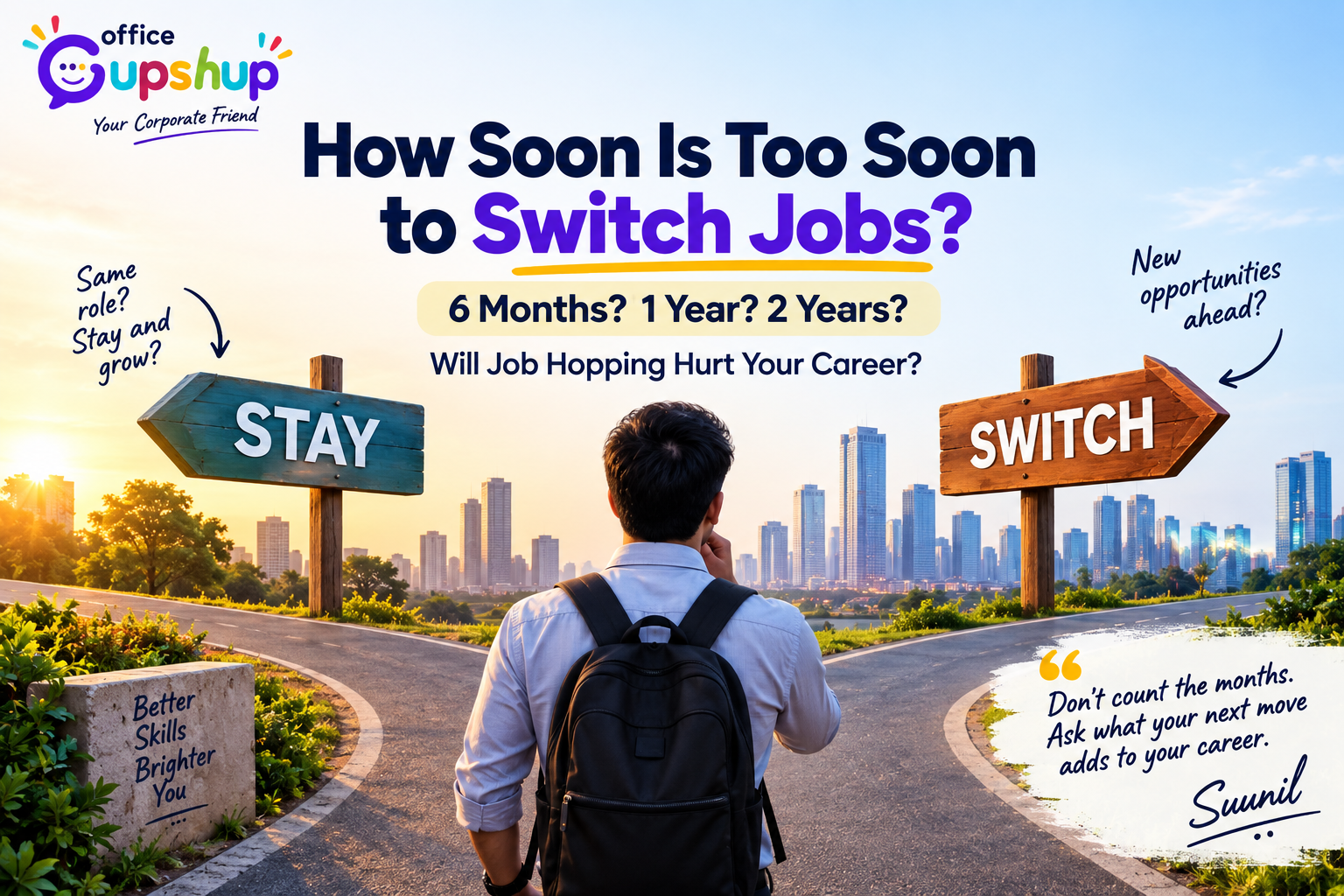
Don’t count how many months you’ve stayed. Ask what the next move adds to your career.
Your career isn’t a loyalty contest.
But it isn’t a race to collect the maximum number of company names on your CV either.
Build a career where each move has a reason.
Got an Offer but Not Sure Whether to Stay or Switch?
Maybe the salary is better, but the role isn’t.
Maybe you’ve only been with your current company for eight months.
Maybe you’ve stopped learning but aren’t sure whether that’s enough reason to leave.
Or perhaps you simply need to discuss the decision with someone who isn’t your boss, recruiter or colleague.
That’s exactly what Office Gupshup is for.
☕ Talk it through with your Corporate Friend.
Book a FREE 10-minute chat.
No corporate jargon. No judgement. Just a practical conversation about the decision in front of you.
Office Gupshup | Your Corporate Friend



[…] 👉 How Soon Is Too Soon to Switch Jobs? Will Job Hopping Hurt Your Career in India? […]
[…] you’re still deciding whether to make the move, read How Soon Is Too Soon to Switch Jobs?. If you’ve already decided and the notice period is standing in your way, here’s what to do […]
[…] If you’re still at an earlier stage of deciding whether switching itself makes sense, read How Soon Is Too Soon to Switch Jobs? Will Job Hopping Hurt Your Career in India?. […]
[…] 👉 How Soon Is Too Soon to Switch Jobs? Will Job Hopping Hurt Your Career in India? […]