
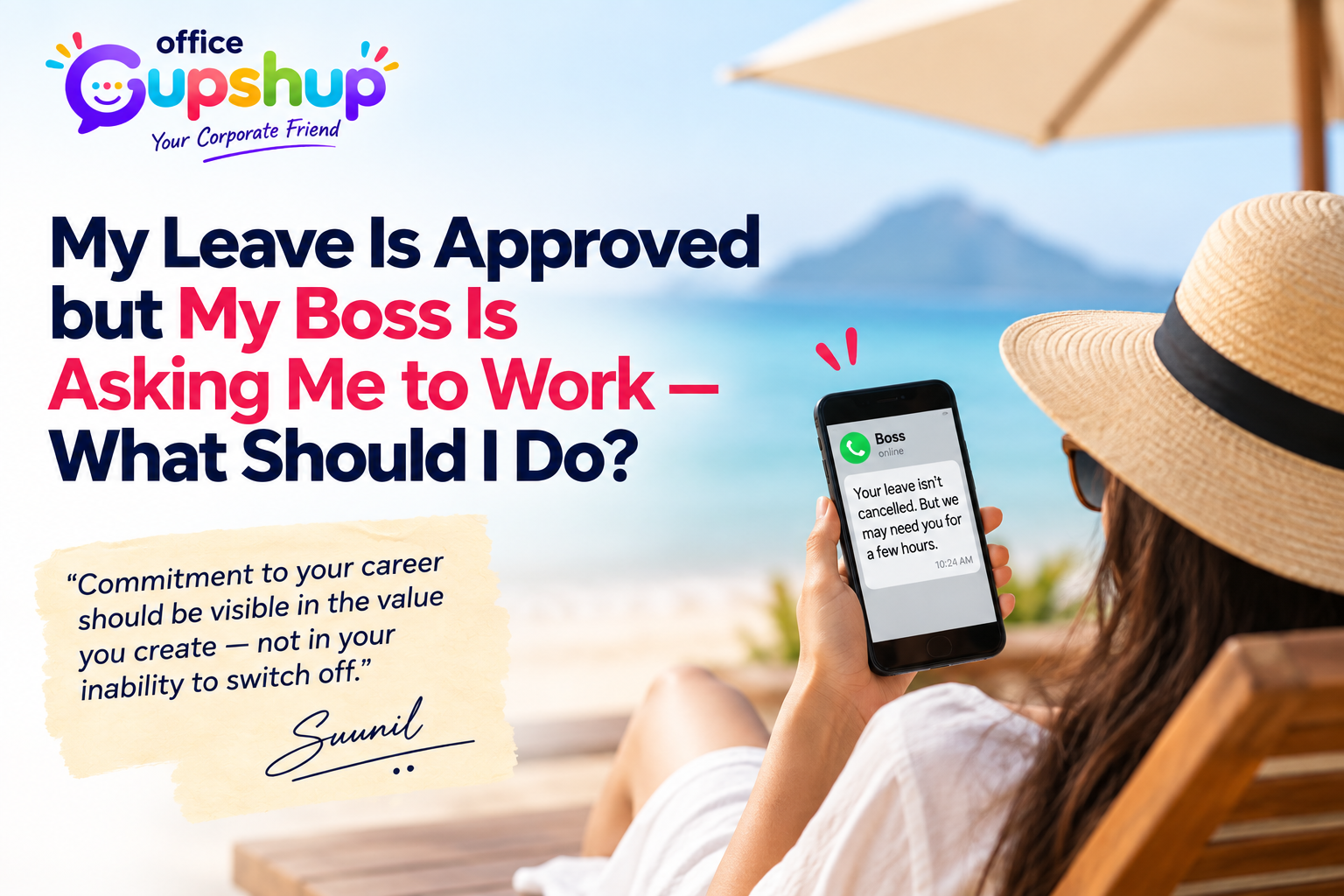
Your leave was approved weeks ago.
Tickets are booked.
Family plans are made.
Your laptop is shut.
For once, you are mentally beginning to switch off from work.
And then your phone buzzes.
Your manager messages:
“Your leave is not cancelled, but we may need your help for a few hours.”
Now what?
Do you say no?
Do you log in because you do not want to look uncommitted?
Do you ignore the message?
What if it is genuinely urgent?
And the question that worries many young professionals the most:
“If I refuse to work during approved leave, will my boss remember it during my appraisal?”
Welcome to one of those corporate situations where the official answer and the practical answer may not always feel the same.
Why Is Everyone Talking About Working During Approved Leave?
The question became particularly relevant after a workplace message reportedly went viral around Ganesh Chaturthi.
According to The Economic Times, an employee shared a senior manager’s WhatsApp message saying that people whose leave had already been approved might still be contacted for a few hours of assistance if required.
The report says the employee claimed the leave had been approved around a month earlier.
The manager was apparently not cancelling the leave.
That is precisely what makes the situation interesting.
If your leave is approved but you are still expected to remain available, are you actually on leave?
The individual social-media claims in the viral incident have not been independently verified, so there is little value in judging that particular manager or company from one screenshot.
But the workplace dilemma is very real.
Many employees have faced some version of:
“Enjoy your leave… but keep your phone nearby.”
So let us forget the viral debate for a moment.
What should YOU actually do if this happens to you?
First: Not Every Call During Leave Means Your Boss Is Toxic
This distinction is important.
Imagine you are on leave and your manager calls because:
- Only you know the password location for an urgent client file.
- A transaction you handled before leaving has unexpectedly failed.
- A major customer issue has occurred and your knowledge could resolve it in five minutes.
- There is a genuine business emergency nobody reasonably anticipated.
A manager asking:
“Sorry to disturb you. Can you help me with something urgently for five minutes?”
is very different from:
“You are on leave, but keep checking emails throughout the day because we may need you.”
One is an exceptional request.
The other can effectively turn your leave into unofficial work-from-home.
The real question is not simply: “Did my boss contact me?”
Ask instead:
Was this genuinely exceptional — or is being available during leave becoming an expectation?
That distinction changes everything.
1. Understand Whether It Is a Request or an Expectation
Corporate communication is often wonderfully vague.
Your manager may say:
“If possible, could you please log in for some time?”
Technically, it sounds optional.
But you may hear:
“If you care about your career, you will log in.”
That gap between the words spoken and the pressure felt is where young employees often become confused.
Before reacting, understand what is actually being requested.
Ask:
- Is there a genuine emergency?
- How much time is actually required?
- Can somebody else handle it?
- Is my manager asking for help or assuming availability?
- Is this a one-time situation?
- Does this happen every time somebody takes leave?
- Was this possibility communicated before my leave was approved?
Do not automatically assume the worst.
But do not automatically surrender your boundary either.
2. If You Can Help Briefly and Want To, Help — But Define the Boundary
Suppose you are at home.
The request is genuinely urgent.
It will take ten minutes.
And you are comfortable helping.
There is nothing wrong with doing so.
Being professional does not require becoming rigid.
But there is an important difference between:
helping during an exceptional situation
and
quietly establishing that you are permanently available during leave.
You could respond:
“Sure, I can help with this specific issue. I am away from my laptop after that, so please send me exactly what you need.”
Notice what that message does.
You are helping.
But you are also communicating that the assistance is limited.
That is a healthy professional boundary.
3. If You Cannot Work, Do Not Invent an Elaborate Excuse
This is where many employees make the situation worse.
You are travelling.
Your manager asks you to log in.
Instead of simply explaining that you are unavailable, you create an entire story:
“My laptop charger is not working.”
“Network is very bad here.”
“I left my laptop somewhere else.”
“My phone battery is dying.”
The more complicated the excuse, the more uncomfortable you become.
If your leave was approved and you genuinely cannot work, communicate calmly.
For example:
“I understand this is urgent. Unfortunately, I am away as planned and do not have the ability to log in today. I can pick this up when I return on Wednesday.”
Or:
“I am travelling with family today and will not be able to join. If there is something I can clarify quickly over a message, please send it and I will respond when possible.”
Professional.
Clear.
No drama.
No five-paragraph explanation.
No angry WhatsApp.
No fake network problem.
4. Avoid the Angry “I AM ON LEAVE!” Reply
You may be completely justified in feeling irritated.
But your first emotional response is rarely your best professional response.
Imagine receiving this message during your vacation:
“Join the call at 4 PM.”
Your instinct may be:
“I AM ON LEAVE. Why was my leave approved if you expect me to work?”
Understandable.
But probably not the smartest first response.
A better version could be:
“I am on approved leave today and have commitments that make it difficult for me to join at 4 PM. Is there something specific you need from me that I can clarify before the call?”
Same boundary.
Very different tone.
This is a broader workplace skill: learning to disagree or push back without turning every disagreement into a confrontation.
We explored this in detail in 12 Things Smart Employees Should Never Say to Their Boss — And What to Say Instead.
Your objective is not to win the WhatsApp argument.
Your objective is to protect your time without unnecessarily damaging the working relationship.
5. Ask Yourself: Is This Really an Emergency?
Every organisation has emergencies.
But some organisations have an amazing number of “emergencies” every Friday evening.
There is a difference.
A genuine emergency is usually:
- Unusual
- Difficult to predict
- Time-sensitive
- Material to the business
- Not easily handled by somebody else
But if the same situation happens repeatedly, it may no longer be an emergency.
It may be a planning problem.
If employees on leave are routinely contacted because:
- There is no backup.
- Knowledge sits with one person.
- Staffing is permanently stretched.
- Managers plan work at the last minute.
- Nobody documents processes.
- Every client request is labelled urgent.
then the problem is bigger than one interrupted holiday.
A recurring emergency is often a process wearing an emergency costume.
And employees should be careful about silently becoming the permanent solution to poor planning.
6. “But What If My Boss Thinks I Am Not Committed?”
This is probably the real question.
Not:
“Can I refuse?”
But:
“What will happen to my career if I refuse?”
Young professionals often worry that boundaries will be interpreted as lack of commitment.
That fear is understandable.
Workplaces are not machines where every decision is evaluated without human judgement.
Managers form perceptions.
Colleagues form perceptions.
Your reputation matters.
But there is another side to this.
Permanent availability is not the same as professional commitment.
A reliable employee is someone who:
- Delivers consistently.
- Communicates problems early.
- Takes ownership.
- Helps colleagues reasonably.
- Plans leave properly.
- Completes handovers.
- Responds professionally.
- Can be trusted with responsibility.
None of those require being available 24×7.
In fact, one of the 9 Workplace Truths Your Boss May Never Tell You is that being permanently available does not automatically make you indispensable.
Your career should be built on the value you create — not on how quickly you respond to WhatsApp while sitting at a family function.
7. Before Going on Leave, Make It Difficult for People to Need You
This is one of the most practical things you can do.
A few days before planned leave:
Finish what can reasonably be finished.
Do not knowingly leave avoidable fires burning.
Create a proper handover.
Mention:
- Pending tasks
- Deadlines
- Key contacts
- Important files
- Current status
- Possible risks
- Who can handle what
Inform relevant stakeholders.
Do not assume everybody knows you are on leave simply because HR approved it.
Nominate a backup wherever possible.
Make sure the person has the information required.
Flag foreseeable issues before leaving.
If you already know something could become urgent, discuss it beforehand.
This changes the conversation dramatically.
Instead of:
“Suunil disappeared and now nobody knows what is happening.”
it becomes:
“Suunil completed the handover, documented everything and is now on approved leave.”
Good boundaries become much easier to defend when you have fulfilled your responsibilities professionally.
8. What If Your Boss Keeps Calling During Every Leave?
Once?
Maybe an emergency.
Twice?
Possibly bad luck.
Every vacation?
Now you have a pattern.
Do not immediately start a fight.
Start observing.
Ask yourself:
- Does this happen only to me or to everybody?
- Is my role genuinely operationally critical?
- Have I failed to create an adequate backup?
- Does my manager contact everyone outside working hours?
- Are these genuine emergencies?
- Am I expected to respond immediately?
- Is there an explicit on-call arrangement?
- Is this expectation part of my role?
- Was it communicated when I joined?
- Is working during leave being treated as normal?
Patterns matter more than isolated incidents.
If repeated boundary violations are part of a larger problem with your manager, you may also find My Boss Keeps Shouting at Me — Should I Quit? 7 Things to Do Before You Resign useful.
The behaviour is different, but the principle is similar:
Do not make a major career decision based only on one emotional incident. Understand the pattern first.
9. Should You Ignore Your Boss’s Message Completely?
Usually, that should not be your first strategy.
Ignoring a message may feel satisfying for five minutes.
But if you have seen it and can reasonably respond, a clear boundary is often better than silence.
You can say:
“I have seen your message. I am currently away on approved leave and will not be able to log in. I will take this up first thing when I return.”
Now there is no ambiguity.
Your manager knows:
You received the request.
You understood it.
You are unavailable.
And you communicated professionally.
That is generally stronger than disappearing and later saying:
“Sorry, didn’t see WhatsApp.”
10. What If Your Boss Says, “Everyone Else Is Working”?
This is where workplace pressure becomes more complicated.
Maybe three colleagues cancelled their plans.
Maybe somebody logged in from their hotel.
Maybe another employee always answers calls on Sunday.
That does not automatically mean you should make the same decision.
But avoid responding with:
“That’s their problem.”
Instead:
“I understand the team is under pressure. Since my leave was approved and I have already made commitments, I am not available to work today. I completed the handover before leaving. If there is a specific question I can clarify quickly, please message me.”
Again:
Empathy + clarity + boundary.
11. What If You Are Worried About Appraisal or Office Politics?
Now we enter the uncomfortable part.
Suppose your boss says:
“Fine. Enjoy your leave.”
But the tone says something completely different.
You start wondering:
Will this come up during appraisal?
Will I be called “not flexible”?
Will somebody who worked during the holiday be considered more committed?
There is no universal answer.
Different managers and organisations behave differently.
This is why workplace awareness matters.
If you are already dealing with favouritism, visibility issues or informal power dynamics, read How to Deal With Office Politics in an Indian Workplace Without Becoming Political Yourself.
But do not become paranoid either.
One professionally communicated boundary does not automatically destroy a career.
Your broader reputation matters far more.
Build a reputation for reliability during working time so that reasonable unavailability during personal time does not become your defining characteristic.
12. When Should You Document the Situation?
You do not need to screenshot every “Hi” from your manager as though you are preparing for a court case.
But documentation becomes useful when there is a repeated pattern.
For example:
- Approved leave is repeatedly disturbed.
- You are being asked to perform substantial work during leave.
- Instructions about availability keep changing.
- You are later criticised for not working during approved leave.
- Your leave is effectively being converted into working time.
- There is disagreement about what was communicated.
- You believe retaliation is occurring because you were unavailable.
Keep relevant communications.
Keep your leave approval.
Keep your handover.
And if necessary, move an important discussion from a casual call to an appropriate written channel.
Not because every manager is an enemy.
Because clarity protects everyone.
13. Is an Employee Legally Required to Work During Approved Leave in India?
This is where simple internet answers can become misleading.
There is no useful one-line answer that applies identically to every employee in India.
Your position can depend on factors including:
- The nature of your employment
- Applicable labour laws
- State-specific rules
- Your establishment
- Employment contract
- Certified or applicable standing orders
- Company leave policies
- Nature of the role
- Whether an on-call arrangement exists
- The type of leave or holiday involved
So be cautious with dramatic social-media statements such as:
“It is illegal for your boss to contact you on leave.”
or
“Your company can make you work whenever it wants.”
Workplace reality and legal rights can be more nuanced.
If your situation involves repeated denial or cancellation of statutory leave, unpaid wages, forced work, retaliation or another matter with legal implications, obtain advice from an appropriately qualified professional rather than relying on a viral post or a generic article.
Office Gupshup’s focus here is practical career navigation — not individual legal advice.
14. Five Responses You Can Actually Send Your Boss
Here are practical responses for different situations.
Situation 1: You Can Help for a Few Minutes
“Sure, I can help with this specific issue. Please send me what you need. I am away from my laptop after that, so I may not be available later.”
Situation 2: You Cannot Log In
“I understand this is urgent. I am currently away on approved leave and unfortunately will not be able to log in today. I can take this up when I return.”
Situation 3: You Are Travelling but Can Clarify Something Quickly
“I am travelling and don’t have access to my laptop. If there is a specific question I can clarify over WhatsApp, please send it and I will respond when possible.”
Situation 4: Your Manager Wants Several Hours of Work
“I had planned today based on my approved leave and will not be available for a work session. If the matter can wait, I will prioritise it when I return. If something needs immediate attention, perhaps we can identify someone from the team who is available today.”
Situation 5: This Keeps Happening
“I am happy to support genuine emergencies when reasonably possible. However, I have noticed that I am regularly being contacted during planned leave. Can we discuss a backup or handover arrangement so that the team is covered when I am away?”
That last conversation may feel uncomfortable.
But healthy professional relationships sometimes require uncomfortable conversations.
The Office Gupshup L.E.A.V.E. Rule
The next time your phone buzzes during approved leave, remember:
L — Look at the Situation
Is this genuinely urgent or simply convenient?
E — Evaluate the Request
Five minutes of clarification and five hours of work are not the same thing.
A — Answer Calmly
Do not respond from irritation.
V — Voice Your Boundary
If you cannot work, communicate that clearly and professionally.
E — Examine the Pattern
One unusual request may be understandable.
Repeated intrusion into approved leave deserves a larger conversation.
The Bigger Question: Are You Ever Really Switching Off?
There is another issue hiding behind this discussion.
Sometimes the boss does not even need to call.
You are on leave but still:
Checking Teams.
Refreshing Outlook.
Reading office WhatsApp groups.
Replying to “small” questions.
Checking whether your boss has messaged.
Thinking about Monday.
Worrying that somebody else is getting visibility while you are away.
In that case, technically you are on leave.
Mentally, you are still in the office.
Rest is not only about where your laptop is.
It is also about whether your mind has permission to disconnect.
A career is a marathon.
You cannot spend decades professionally available every waking hour and expect that to have no cost.
Final Gupshup
Approved leave should ideally mean something.
But corporate life is rarely solved by shouting:
“MY LEAVE IS APPROVED!”
There may be genuine emergencies.
There may be unreasonable managers.
There may be poor planning.
There may be roles where occasional availability is genuinely part of the responsibility.
And sometimes you may voluntarily choose to help because you care about your team.
The important thing is to know the difference between:
helping occasionally
and
being permanently available.
Between:
professional flexibility
and
having no boundaries.
Between:
one genuine emergency
and
someone else’s poor planning becoming your permanent problem.
And most importantly:
Do not say yes only because you are scared to say no.
Respond based on the situation, your responsibilities and the professional relationship you want to build.
“Commitment to your career should be visible in the value you create — not in your inability to switch off.”
— Dr Suunil
Boss Disturbing Your Approved Leave? Unsure How to Respond?
Maybe your boss keeps calling during leave.
Maybe you have already said yes too many times and do not know how to set a boundary now.
Maybe you want to say no but are worried about your appraisal.
Maybe the problem is bigger than leave — and you are struggling with your manager, office politics, workload, career decisions or whether you should stay in the organisation.
Do not send an angry WhatsApp.
Do not resign in frustration.
And do not keep overthinking the situation alone.
Office Gupshup — Your Corporate Friend
Facing a workplace or career challenge?
Bring the real situation.
Let’s Gupshup about it.
No corporate gyaan.
No judgement.
Just a practical conversation about what is happening, what your options are and what you can do next.
Office Gupshup provides mentoring and practical conversations around workplace and career situations. This article is general informational content and does not constitute legal, HR, employment or other professional advice. Employment rights and obligations can depend on applicable law, employment terms, workplace policies and individual circumstances.
#BossCallingOnLeave #ApprovedLeave #BossProblems #CareerAdvice #CorporateLife #DrSuunil #EmployeeBoundaries #IndianWorkplace #ManagerProblems #OfficeGupshup #WorkLifeBalance #WorkplaceAdvice



[…] work boundaries are already an issue in your current job, our guide on what to do when your boss asks you to work during approved leave may also […]