
Job interviews are not examinations where there is one perfect answer.
Yet many candidates prepare for interviews exactly like exams. They memorise answers, practise impressive phrases and try to predict what the interviewer wants to hear.
The result?
They often sound rehearsed rather than convincing.
A good HR interview is usually trying to understand something much simpler:
Who are you professionally?
Why do you want this job?
How do you work with people?
How do you respond to pressure, feedback and failure?
And are you likely to succeed in this organisation?
The best interview answers therefore do not need complicated vocabulary. They need clarity, relevance, examples and honesty.
Here are 33 common HR interview questions, what the interviewer may actually be trying to understand, and how you can answer them naturally.
1. Tell Me About Yourself
What HR wants to understand:
Can you introduce yourself professionally and connect your experience to the position?
Smart answer:
“Sure. I have been working in [field] for the last [X years], primarily across [key areas]. In my current role, I handle [relevant responsibilities]. One achievement I am particularly proud of is [specific achievement]. I am now looking for an opportunity where I can use this experience while taking on greater responsibility.”
Avoid:
Giving your entire life story.
Your answer should primarily be about your professional journey, not where you were born, your family background or unrelated personal information.
2. Why Do You Want This Job?
What HR wants to understand:
Are you genuinely interested in this role, or simply applying everywhere?
Smart answer:
“This role interests me because it combines my experience in [skill] with an opportunity to develop further in [area]. From the job description, I believe my background in [relevant experience] fits the requirements well.”
Avoid:
“I just need a job.”
Even if that is partly true, employers want to understand why this particular opportunity interests you.
3. Why Do You Want to Work Here?
This question is about the organisation, not merely the position.
Smart answer:
“I have been following the company’s work in [area]. I particularly like [specific business, product, culture or growth factor]. The opportunity to contribute to that environment while developing my own capabilities is what attracted me.”
Office Gupshup Tip:
Spend 15–20 minutes researching the company before your interview.
You should know what they do.
4. What Do You Know About Our Company?
Never answer:
“Not much.”
Research beforehand.
Smart answer:
“My understanding is that the company operates primarily in [industry/business]. I also noticed your recent focus on [product, expansion, initiative or business area]. I found that particularly interesting because it connects well with my experience in [relevant skill].”
You do not need to know everything.
But you should demonstrate genuine preparation.
5. Why Should We Hire You?
Do not simply describe yourself as hardworking.
Almost everyone says that.
Connect your abilities to the employer’s requirement.
Smart answer:
“I believe there are three things I can bring to this role: experience in [skill], a strong understanding of [relevant area], and the ability to [specific capability]. In my previous role, I used these skills to [brief result]. I believe that experience would allow me to contribute relatively quickly here.”
Evidence is stronger than adjectives.
6. What Are Your Biggest Strengths?
Choose strengths relevant to the job.
Smart answer:
“One of my strengths is structured problem-solving. When I face a complex issue, I generally break it into smaller parts, identify the root cause and then prioritise solutions. That approach helped me recently when [brief example].”
Notice the difference.
Instead of simply claiming a strength, you demonstrate it.
7. What Is Your Biggest Weakness?
Please retire this answer:
“I am a perfectionist.”
Interviewers have heard it thousands of times.
Choose a genuine weakness that you are actively improving.
Smart answer:
“Earlier, I sometimes spent too much time trying to solve problems independently before asking for help. I realised that this could slow things down. I have become much better at recognising when collaboration will produce a faster result.”
A good weakness answer shows:
Self-awareness + improvement.
8. Why Did You Leave Your Last Job?
Never turn this into a complaint session about your previous employer.
Even if your experience was terrible.
Smart answer:
“I learned a great deal in my previous role, but I reached a point where I wanted broader responsibilities and exposure to [area]. I felt it was the right time to explore opportunities aligned with the next stage of my career.”
If you were laid off, say so honestly.
If you were terminated, explain the situation maturely and focus on what you learned.
9. Why Are You Looking for a New Job?
This sounds similar to the previous question but focuses more on what you want next.
Smart answer:
“I am looking for a role where I can build on my experience in [area] while gaining greater exposure to [new responsibility]. I am particularly interested in opportunities where I can contribute meaningfully and continue developing professionally.”
10. What Are You Looking for in Your Next Job?
Avoid creating a shopping list.
Smart answer:
“I am looking for meaningful responsibilities, opportunities to learn and an environment where performance and ownership are valued. The role itself is important to me, but so is the opportunity to continue developing.”
11. Where Do You See Yourself in Five Years?
Nobody expects you to predict your exact designation in five years.
The interviewer wants to understand your direction and ambition.
Smart answer:
“In five years, I would like to have developed deeper expertise in [area], taken responsibility for larger projects and become someone the organisation can trust with more complex challenges.”
That sounds ambitious without pretending you already know your future job title.
12. What Motivates You?
Money can be a motivator.
But it should probably not be your entire answer.
Smart answer:
“I enjoy seeing measurable progress. Solving a difficult problem, learning something new and seeing my work create a tangible result gives me a strong sense of satisfaction.”
Make the answer personal.
What genuinely makes you want to perform?
13. What Are Your Career Goals?
Your goals should have some connection with the position you are interviewing for.
Smart answer:
“My immediate goal is to strengthen my capabilities in [area] and take on more challenging responsibilities. Over time, I would like to develop into a role where I can combine subject expertise with greater ownership and leadership.”
14. What Makes You a Good Fit for This Role?
Do not simply say:
“My experience matches the job description.”
Explain how.
Smart answer:
“The role requires experience in [A], [B] and [C]. I have worked directly on [A and B], and in my current role I have also gained exposure to [C]. I believe that combination allows me to understand the requirements and contribute quickly.”
15. Can You Work Under Pressure?
Almost everyone says yes.
Examples make the answer believable.
Smart answer:
“Yes. I try to manage pressure by separating urgency from importance and creating clear priorities. For example, during [situation], we had a very tight deadline. I reorganised the tasks, aligned responsibilities with the team and we completed the work on schedule.”
16. How Do You Handle Stress?
Do not pretend you never experience stress.
That sounds unrealistic.
Smart answer:
“I handle stress best when I create structure around the situation. I identify what needs immediate attention, break larger problems into manageable tasks and focus on what I can control.”
17. How Do You Handle Criticism?
The interviewer is testing your coachability.
Smart answer:
“My first priority is to understand the feedback rather than immediately defend myself. If something is unclear, I ask for examples. Then I evaluate what needs to change and work on it.”
You do not need to agree with every piece of criticism.
But you should be able to receive feedback professionally.
18. How Do You Handle Conflict?
Avoid saying:
“I never have conflicts.”
If you work with humans, disagreements will happen.
Smart answer:
“I try to separate the person from the issue. I first understand the other person’s perspective, explain mine clearly and then focus on what outcome works best for the project or organisation.”
Professional conflict resolution is not about proving who is right.
It is about finding a workable solution.
19. Are You a Team Player?
Do not stop at:
“Yes.”
Smart answer:
“Yes. I enjoy collaborative work, particularly when different people bring different strengths to a problem. At the same time, I am comfortable taking individual ownership when required.”
This also avoids implying that you cannot work independently.
20. Do You Prefer Working Alone or With a Team?
Usually, the safest truthful answer is flexibility.
Smart answer:
“It depends on the work. Tasks requiring concentration and analysis may be more efficient individually, while projects involving multiple functions benefit from collaboration. I am comfortable with both.”
21. How Do You Prioritise Your Work?
Saying “I do the important things first” is not enough.
Smart answer:
“I usually evaluate tasks based on urgency, business impact and dependencies. I identify what could block other people or affect a deadline and prioritise accordingly. I also review priorities when new information comes in.”
That sounds like someone who actually understands prioritisation.
22. How Do You Stay Organised?
Smart answer:
“I maintain a clear task list with deadlines and priorities. For larger projects, I break the work into milestones and review progress regularly rather than waiting until the deadline approaches.”
Simple.
Practical.
Believable.
23. How Do You Manage Deadlines?
Smart answer:
“I start by understanding the final deliverable and deadline, then work backwards into smaller milestones. If I see a potential delay, I communicate it early rather than waiting until the last day.”
That last sentence matters.
Good professionals do not just manage deadlines.
They communicate risks early.
24. What Do You Do When You Make a Mistake?
Never say:
“I rarely make mistakes.”
Everyone makes mistakes.
Smart answer:
“My first priority is to understand the impact and correct the problem quickly. I take responsibility, communicate with the relevant people and then identify what needs to change so that the same mistake does not happen again.”
Three important words:
Own. Fix. Learn.
25. Tell Me About a Challenge You Faced
This is where specific examples become important.
Use a simple structure:
Situation → Challenge → Action → Result
Example:
“We once had a critical client deliverable with a much shorter timeline than expected. I broke the work into priority areas, coordinated responsibilities with the team and created daily progress checkpoints. We completed the critical deliverables on time without compromising quality.”
Do not spend five minutes describing the problem.
Spend more time explaining what you did.
26. Tell Me About a Time You Showed Leadership
Leadership does not necessarily mean managing people.
Smart answer:
“During a project, responsibilities were unclear and progress had slowed. I took the initiative to organise the pending tasks, clarify ownership and establish regular checkpoints. I was not the formal team leader, but taking ownership helped us get the project back on track.”
Leadership often begins before the designation arrives.
27. What Is Your Greatest Accomplishment?
Choose something meaningful and measurable.
Smart answer:
“One achievement I am particularly proud of was [project]. I was responsible for [your contribution], and the result was [measurable outcome]. What made it especially meaningful was [reason].”
Whenever possible, quantify the impact.
Revenue.
Savings.
Time saved.
Growth.
Customers served.
Error reduction.
Efficiency improvement.
Numbers make achievements easier to understand.
28. What Are You Most Proud Of?
This question can be broader than your greatest accomplishment.
Smart answer:
“I am proud of how much responsibility I have gradually been able to take on. Earlier in my career I primarily executed assigned tasks, whereas today I am much more comfortable taking ownership, making decisions and helping others solve problems.”
This demonstrates growth, not just one achievement.
29. What Is Your Work Style?
Avoid vague labels.
Smart answer:
“I would describe my work style as structured but flexible. I like clear priorities and timelines, but I am comfortable adjusting when business requirements change. I also prefer communicating early when I see a potential issue.”
30. How Would Your Coworkers Describe You?
Think about what colleagues genuinely come to you for.
Smart answer:
“I think they would describe me as dependable and approachable. People generally know that if I commit to something, I will follow through, and I am usually happy to help when someone needs support.”
31. How Would Your Manager Describe You?
Ideally, your answer should be consistent with your actual performance feedback.
Smart answer:
“I believe my manager would describe me as dependable, responsible and willing to take ownership. One piece of feedback I have received consistently is that I remain calm when difficult issues need to be resolved.”
32. What Kind of Work Environment Do You Prefer?
Be honest.
You are evaluating the company too.
Smart answer:
“I work best in an environment where expectations are clear, people communicate openly and employees are trusted to take ownership. I also value a culture where constructive feedback is normal.”
Do not simply say whatever you think the interviewer wants to hear.
A cultural mismatch hurts both sides.
33. What Do You Expect From a Manager?
Be careful not to describe your dream boss.
Smart answer:
“I appreciate managers who communicate expectations clearly, provide honest feedback and give people enough ownership to do their jobs. I am comfortable being challenged as long as expectations and feedback are clear.”
The Biggest Interview Mistake: Memorising Answers
There is one problem with every sample answer in this article.
It is not your answer yet.
If 100 candidates memorise:
“I am hardworking, motivated, dependable and eager to learn.”
then those words tell the interviewer almost nothing.
Your answers become powerful when you add:
Your experience.
Your examples.
Your numbers.
Your mistakes.
Your learning.
Your personality.
Use sample answers to understand the structure, not to memorise the sentences.
A Simple Office Gupshup Formula for Better Interview Answers
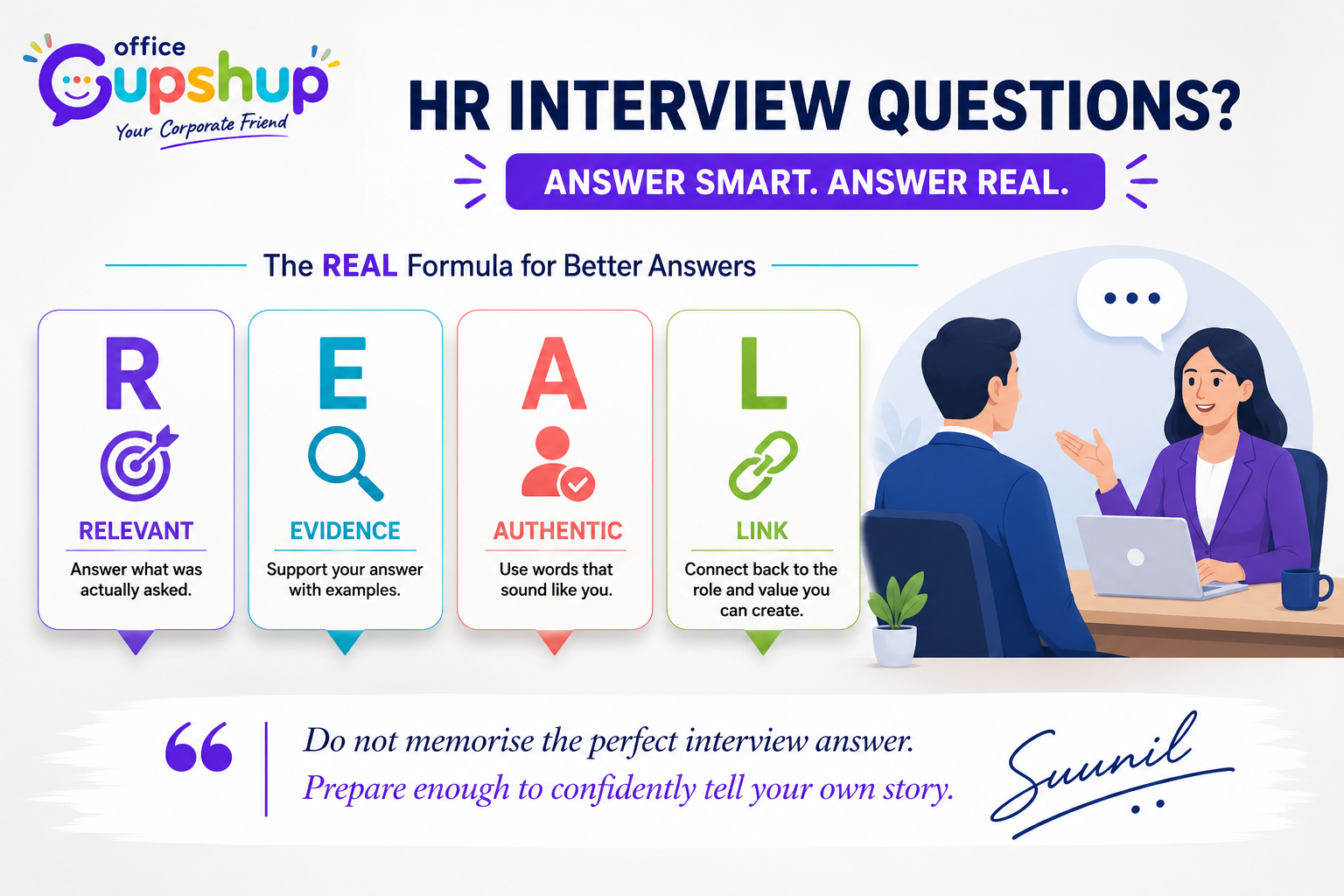
For most interview questions, remember R.E.A.L.
R — Relevant
Answer what was actually asked.
E — Evidence
Whenever possible, support your statement with an example.
A — Authentic
Use language you would naturally speak.
L — Link
Connect your answer back to the job, your learning or the value you can create.
The interviewer is not looking for the candidate who memorised the best sentences.
They are looking for someone they can understand, trust and imagine working with.
7 Things You Should Never Do in an HR Interview
Avoid these common mistakes:
- Speaking negatively about your previous boss or employer
- Giving extremely long answers
- Pretending you have no weaknesses
- Providing answers that you clearly memorised
- Lying about experience or achievements
- Giving vague answers without examples
- Failing to research the company and role
And remember: confidence is not knowing every answer. Confidence is being comfortable answering honestly and clearly.
Final Thoughts
A successful interview is not about producing the “perfect answer” to every question.
It is about helping the interviewer understand three things:
Can you do the job?
Do you genuinely want the job?
Will people want to work with you?
Prepare thoroughly, but do not memorise yourself into becoming someone else.
Know your achievements.
Know your mistakes.
Know your strengths.
Understand the company.
Prepare examples.
And then have a conversation, not a performance.
At Office Gupshup, we believe interview preparation should help you communicate the best version of your real professional self—not manufacture a personality for 45 minutes.
“Do not memorise the perfect interview answer. Prepare enough to confidently tell your own story.”



[…] 33 Common HR Interview Questions and Smart Answers can help you prepare for your next […]