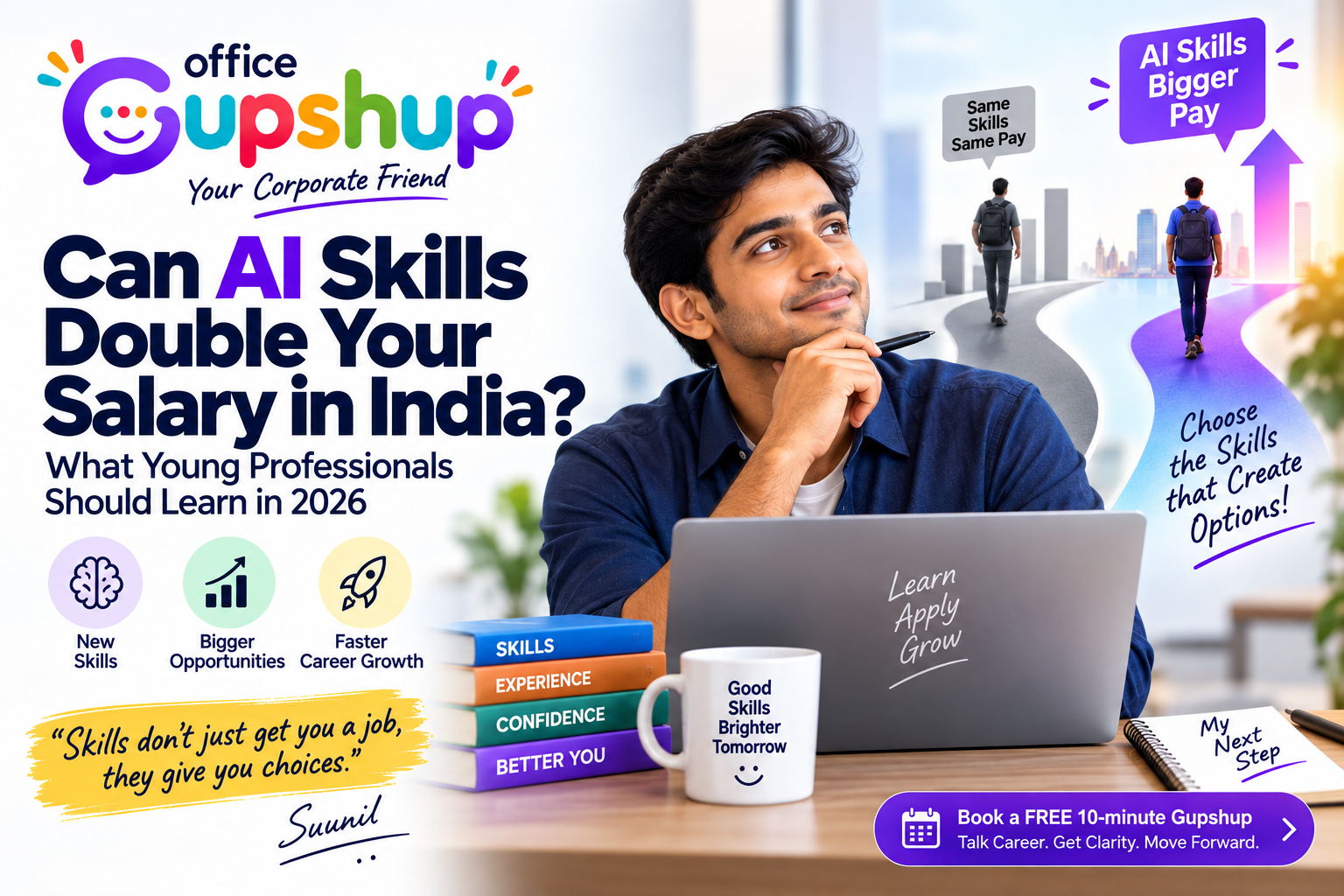
Two freshers join the same company.
Same qualification.
Similar role.
Both start at around ₹5 lakh a year.
One continues doing the job exactly the way it has always been done.
The other learns how to use AI to research faster, analyse information better, automate repetitive work, improve presentations, draft more effectively and solve problems quicker.
Two years later, could their salaries look very different?
Possibly.
And that is why one of the most important career questions in 2026 may no longer be:
“Will AI take my job?”
It may be:
“Will someone who uses AI better than me take my next promotion?”
That sounds dramatic.
But the salary data emerging around AI skills deserves attention.
PwC’s 2026 Global AI Jobs Barometer found that jobs requiring specific AI skills carried an average advertised wage premium of about 62% compared with non-AI jobs in its analysis.
Recent reporting from India has also suggested that some AI-skilled entry-level roles can command salaries in the region of ₹6–12 lakh per year, compared with approximately ₹3–6 lakh for comparable non-AI-skilled entry-level opportunities.
But before you rush to add “AI Expert” to your LinkedIn headline, there is something much more important to understand.
Learning ChatGPT Will Not Automatically Double Your Salary
This is where headlines can become dangerous.
A 62% AI wage premium does not mean:
Learn five prompts → ask for 62% increment.
Nor does a ₹6–12 lakh salary range mean every fresher who uses ChatGPT will suddenly earn ₹12 lakh.
The salary difference can also reflect the nature of the role, industry, location, experience, technical complexity and scarcity of talent.
The better conclusion is this:
Employers appear increasingly willing to pay more when AI capability is combined with useful professional expertise and measurable business value.
That distinction matters.
Because “I know how to use ChatGPT” is becoming less impressive every month.
Soon it may be like saying:
“I know how to use Google.”
Useful?
Yes.
A differentiator?
Probably not.
What Are Employers Actually Paying More For?
The emerging skill equation looks less like:
AI = Higher Salary
and more like:
Domain Knowledge + AI Ability + Judgment + Communication + Results
Imagine two finance professionals.
Employee A
Knows accounting well.
Uses Excel.
Prepares monthly reports manually.
Takes six hours to analyse variances and prepare management commentary.
Employee B
Also understands accounting well.
But knows how to use AI responsibly to:
- analyse large datasets faster,
- identify unusual trends,
- create first drafts of variance commentary,
- research industry comparisons,
- improve management presentations,
- automate repetitive documentation,
- question assumptions and
- communicate insights clearly.
Employee B isn’t necessarily an AI engineer.
They are simply a better finance professional because they know how to use AI as leverage.
That is where the opportunity lies for most Office Gupshup readers.
Do Non-Tech Employees Really Need AI Skills?
Yes.
But not necessarily the AI skills you are imagining.
A marketing professional probably doesn’t need to build a large language model.
An HR executive probably doesn’t need to understand neural-network architecture.
A finance analyst doesn’t necessarily need to become a Python developer.
An operations professional doesn’t need a PhD in machine learning.
What they increasingly need is the ability to understand:
Where can AI make my existing work faster, better or more valuable?
That question applies across functions.
What Should a Finance Professional Learn?
You may use AI for:
- first-level variance analysis,
- financial research,
- summarising lengthy documents,
- drafting management commentary,
- scenario creation,
- analysing datasets,
- creating presentation structures,
- identifying questions to investigate,
- documentation and
- routine process automation.
But the important skill remains financial judgment.
If an AI tool gives you the wrong interpretation of working capital and you confidently present it to the CFO, saying “AI generated it” will not save you.
Your expertise remains your responsibility.
What Should an HR Professional Learn?
AI can help with:
- job-description drafts,
- interview-question preparation,
- policy summaries,
- employee communication,
- training material,
- recruitment research,
- survey analysis and
- repetitive HR documentation.
But AI cannot remove the need for empathy, confidentiality, fairness and judgment.
In fact, as AI becomes more powerful, these human skills may become more important rather than less.
What Should a Marketing Professional Learn?
Marketing professionals can use AI to accelerate:
- content ideation,
- customer research,
- campaign variations,
- competitor analysis,
- SEO research,
- creative briefs,
- data interpretation and
- experimentation.
But there is already an ocean of generic AI-generated content online.
So knowing how to generate content may become less valuable.
Knowing what deserves to be said, to whom, why and with what positioning may become more valuable.
What Should Someone in Operations Learn?
Operations professionals should look for repetitive work.
Ask:
What do I repeatedly copy?
What do I repeatedly check?
What information do I repeatedly summarise?
What report do I repeatedly prepare?
What recurring problem requires the same investigation?
Those are often good starting points for AI-assisted productivity.
You don’t have to automate your entire department.
Saving 30 minutes every working day is already more than 100 hours a year.
Now imagine redirecting those hours toward better analysis, stakeholder conversations and problem-solving.
That creates value.
AI Skills Are Not Just About Prompt Engineering
Prompt engineering receives enormous attention.
And yes, learning how to give AI clear context, instructions, examples and constraints is useful.
But professionals should be careful about building their entire “AI skill” around clever prompts.
Tools will improve.
Interfaces will become easier.
Today’s complicated prompting technique may become tomorrow’s basic software feature.
More durable skills include:
1. Problem Framing
Can you define the actual problem before asking AI to solve it?
2. Domain Expertise
Can you recognise when the answer is wrong?
3. Critical Thinking
Can you question assumptions instead of accepting confident-looking output?
4. Communication
Can you convert analysis into something your boss, client or colleague can understand?
5. Judgment
Do you know when not to use AI?
6. Execution
Can you convert an AI-assisted idea into a real business outcome?
These skills survive tool changes.
The Biggest AI Career Mistake: Becoming Faster at Work That Doesn’t Matter
Suppose AI helps you prepare a report in 20 minutes instead of two hours.
Excellent.
But what if nobody uses that report?
Then you have simply become more efficient at doing low-value work.
This is why young professionals should not ask only:
“How can AI save me time?”
Also ask:
“How can I use the saved time to become more valuable?”
That might mean:
- understanding the business better,
- solving a recurring problem,
- speaking to customers,
- improving a process,
- developing relationships,
- presenting insights,
- learning another skill or
- taking ownership beyond your job description.
This connects directly with something we discuss repeatedly at Office Gupshup:
Hard work and career growth are not always the same thing.
If you haven’t read it, see our guide on 9 Workplace Truths Your Boss May Never Tell You.
Can AI Skills Help You Get Promoted?
Potentially—if those skills create visible business value.
Your boss is unlikely to promote you because:
“Suunil completed 14 courses on generative AI.”
They may notice you because:
“Suunil redesigned this process and reduced the team’s reporting time substantially.”
The skill matters.
The outcome matters more.
And this is where communication becomes important.
You need to be able to explain:
Problem → Action → Result
For example:
“The team was spending almost six hours each week consolidating recurring information. I created an AI-assisted workflow that reduced the initial preparation significantly, while retaining a manual review step for accuracy.”
That sounds far stronger on a CV or during an appraisal than:
“Proficient in ChatGPT.”
Your technical ability gets stronger when people can understand its business impact.
We explored the broader relationship between expertise and communication in The Communication Gap: Why Great Technicians Don’t Always Become Great Leaders.
Can AI Skills Help You Negotiate a Higher Salary?
Possibly.
But don’t walk into your appraisal saying:
“AI professionals earn 62% more, so please increase my salary by 62%.”
Your manager may remember you for the wrong reason.
Instead, salary negotiations should still be built around:
- expanded responsibilities,
- measurable achievements,
- market value,
- difficult-to-replace skills,
- increased productivity,
- revenue contribution,
- cost reduction,
- business impact and
- your current role versus your original role.
AI capability can become part of that argument when it produces results.
If compensation discussions make you uncomfortable, read “How Much Do You Earn?” — Should You Discuss Your Salary With Office Colleagues?.
The same principle applies:
Use salary information for clarity—not comparison.
Your Degree Still Matters. But Demonstrated Ability May Matter More.
One particularly interesting development in India’s GCC sector is the growing demand for professionals who can combine advanced capabilities with real-world implementation.
Employers increasingly want evidence that you can actually apply technology.
That means there may be a big difference between:
Candidate 1
“Completed AI Certification.”
and:
Candidate 2
“Used AI-assisted workflow to reduce weekly reporting effort by 35% while introducing manual validation controls.”
One describes learning.
The other describes impact.
Guess which conversation is more interesting in an interview?
Should Freshers Be Worried About AI?
Freshers shouldn’t panic.
But they should pay attention.
Traditionally, junior employees learnt through routine work:
Create the first draft.
Compile the spreadsheet.
Research the background.
Prepare the basic presentation.
Summarise the meeting.
AI can increasingly perform parts of these tasks.
That creates an interesting problem.
If AI does more beginner-level execution, young professionals may be expected to develop judgment, communication and problem-solving earlier in their careers.
PwC’s 2026 research found that highly AI-exposed entry-level jobs were substantially more likely to demand skills traditionally associated with more senior professionals, including judgment and leadership.
So the answer isn’t:
“Freshers won’t have jobs.”
It may instead be:
“The definition of a useful fresher is changing.”
What Should You Learn in the Next 90 Days?
Don’t try to become an AI expert overnight.
Try this Office Gupshup 90-day approach.
Days 1–30: Learn
Pick one mainstream AI tool and understand it properly.
Learn:
- how to give context,
- how to structure instructions,
- how to request alternatives,
- how to check outputs,
- how hallucinations happen,
- privacy basics and
- what information should never be uploaded.
Do not chase 25 tools.
Master one first.
Days 31–60: Apply
Identify three recurring tasks in your current work.
Use AI to improve them.
Measure:
- time saved,
- errors reduced,
- speed improved,
- quality improved or
- insight gained.
Keep human review wherever necessary.
Days 61–90: Demonstrate
Create evidence.
Not confidential company data.
Evidence of capability.
For example:
Before: Monthly competitor analysis took 4 hours.
After: AI-assisted research created the first information structure in 45 minutes, followed by manual verification and analysis.
Now you have a story for:
Your appraisal.
Your CV.
Your LinkedIn profile.
Your interview.
And perhaps your next salary negotiation.
One Important Warning: Don’t Upload Everything to AI
Career enthusiasm should not override professional responsibility.
Never casually upload:
- customer information,
- passwords,
- unpublished company financials,
- confidential contracts,
- employee information,
- internal strategy documents,
- proprietary code,
- personally identifiable information or
- anything your organisation prohibits.
Understand your company’s AI policy.
If you’re unsure, ask.
Being “AI savvy” while accidentally exposing confidential data will not accelerate your career.
It may do exactly the opposite.
AI Won’t Make Human Skills Irrelevant
Perhaps one of the most interesting parts of the AI transition is that technical capability and human capability are becoming complementary.
If everyone can create a reasonable PowerPoint faster…
Who decides what the presentation should actually say?
If everyone can draft an email…
Who understands whether sending that email is politically wise?
If everyone can analyse information…
Who knows which information matters?
If AI can create 20 solutions…
Who chooses the right one?
That requires judgment.
Communication.
Context.
Trust.
Experience.
Relationships.
Leadership.
These are human career assets.
And your professional network will still matter too.
AI can help you draft the perfect LinkedIn message.
It cannot build a genuine professional relationship for you.
For that, read How to Network at Work Without Feeling Fake, Awkward or Like a “Chamcha”.
So, Can AI Skills Really Double Your Salary?
For some people in some roles, AI-related capability could contribute to dramatically higher compensation.
Current research clearly suggests that certain jobs requiring AI skills are attracting meaningful salary premiums.
But don’t interpret that as:
Learn AI = Double Salary.
A far more useful formula is:
Your Existing Skill × AI Leverage × Business Impact × Human Judgment = Career Value
AI by itself isn’t the career.
It is becoming part of how the career is performed.
The professional who benefits most may not be the person who knows the most AI terminology.
It may be the accountant who closes faster.
The marketer who understands customers better.
The HR professional who makes better decisions.
The operations executive who removes repetitive work.
The analyst who identifies something everybody else missed.
The manager who combines AI speed with human judgment.
And that leads to the Office Gupshup question worth asking yourself today:
If someone with my qualification and experience learns to use AI significantly better than I do, what could they do in my job that I currently cannot?
Your answer may tell you what you should learn next.
Frequently Asked Questions
Can AI Skills Really Increase Salary in India?
Yes, certain roles requiring AI capabilities are attracting salary premiums, but there is no universal percentage increase. Compensation depends on the role, sector, experience, location, technical depth and the business value of the skills involved.
Do I Need Coding Skills to Benefit From AI?
Not necessarily.
Professionals in finance, HR, marketing, operations, sales, consulting and many other functions can benefit from AI without becoming programmers.
The important question is whether AI improves how effectively you perform your existing role.
Is Learning ChatGPT Enough for Career Growth?
No.
Knowing how to operate an AI tool is useful but increasingly basic.
Domain knowledge, critical thinking, judgment, communication and measurable application are stronger long-term differentiators.
Which AI Skill Should a Fresher Learn First?
Begin with practical AI literacy: giving clear instructions, checking outputs, researching effectively, understanding hallucinations, maintaining privacy and applying AI to real work problems.
Do not start by collecting dozens of certificates.
Will AI Replace Entry-Level Jobs?
AI is likely to automate parts of many entry-level jobs, but that doesn’t mean every junior role disappears.
It may mean employers increasingly expect young employees to demonstrate judgment, communication, adaptability and AI-assisted productivity earlier in their careers.
Should I Mention AI Skills on My CV?
Yes—if you can explain what you actually did with them.
“Used AI-assisted analysis to reduce weekly reporting preparation by 30%” is generally much more meaningful than simply writing “AI/ChatGPT proficient.”
Can AI Skills Help During a Salary Negotiation?
They can strengthen your case when you can demonstrate that they improved productivity, quality, revenue, cost, turnaround time or responsibility.
Negotiate around value created, not merely possession of an AI skill.
Confused About What You Should Learn Next?
Maybe everybody around you is suddenly talking about:
AI.
Prompt engineering.
Automation.
Python.
Data analytics.
Certifications.
MBA.
Switching roles.
And now you’re wondering:
“Am I falling behind?”
You don’t necessarily need another ₹50,000 course because LinkedIn made you anxious.
Sometimes you first need clarity about:
Where are you today?
Where are you trying to go?
Which skill could genuinely move you forward?
Office Gupshup — Your Corporate Friend
If you’re confused about your next career move, salary, boss, workplace situation or what skills you should focus on, book a FREE 10-minute Gupshup with Suunil.
No lectures.
No generic motivational gyaan.
Just an honest, practical conversation about your situation and what you might do next.
Because the smartest career decision isn’t learning everything.
It’s knowing what matters next for you.
Office Gupshup provides mentoring and honest conversations about workplace and career matters. Content is intended for general career education and discussion. Individual workplace situations differ, so use your own judgment before acting on any suggestion.
#AIAtWork #AISkills #CareerGrowth #SalaryGrowth #ArtificialIntelligence #FutureOfWork #YoungProfessionals #CareerAdvice #CorporateLife #WorkplaceSkills #OfficeGupshup


[…] principle becomes even more important as technology changes the workplace. In our recent article, Can AI Skills Double Your Salary in India?, we discussed why employers are increasingly interested not merely in whether you possess a skill, […]