
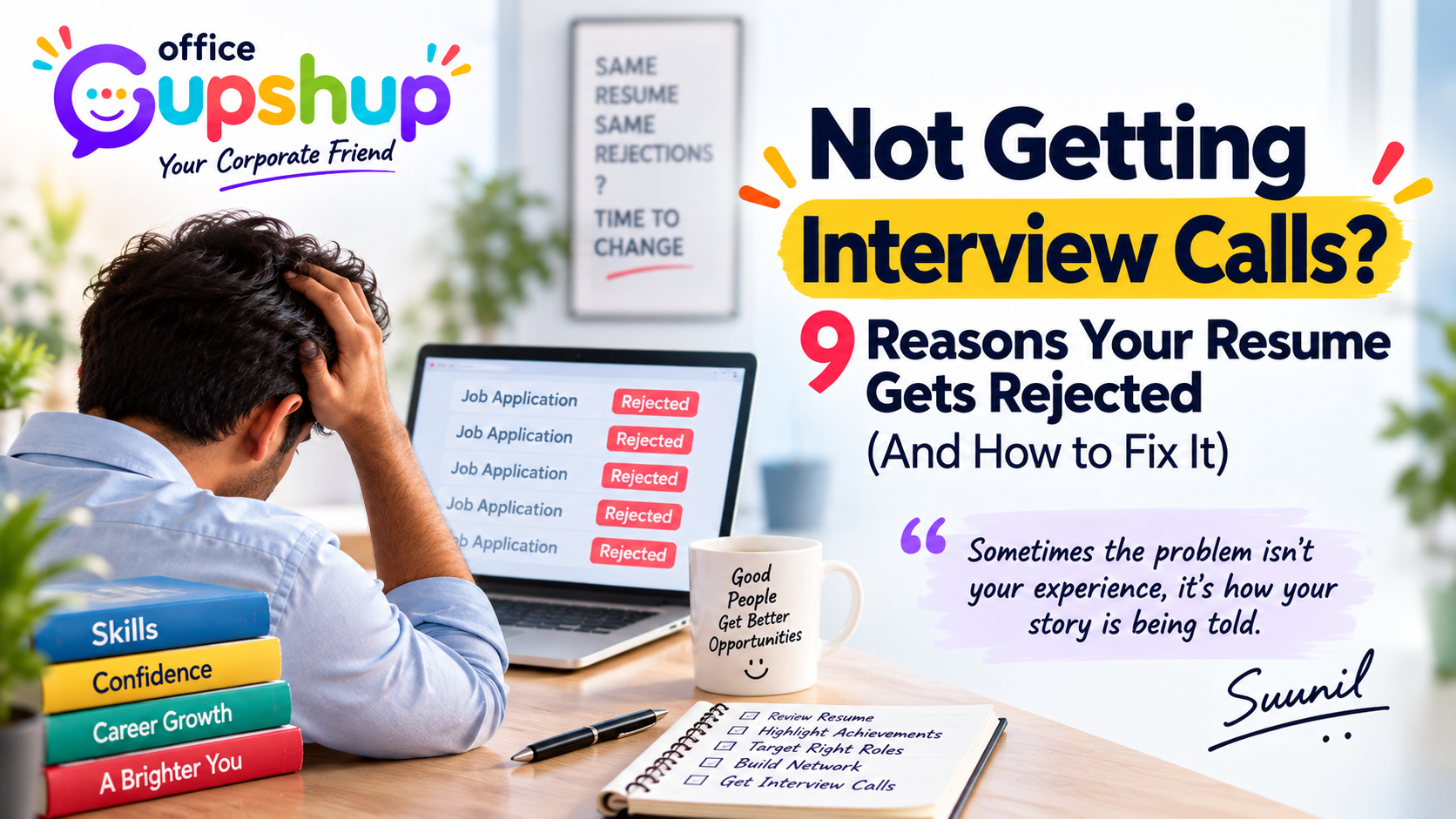
You have applied to 10 jobs.
Then 20.
Then 50.
Your LinkedIn says “Open to Work.”
Your resume has been edited so many times that you no longer remember which version is the latest.
And still…
Silence.
Maybe one automated email:
“Thank you for your interest. After careful consideration…”
You know the rest.
The frustrating part?
You keep hearing that companies are hiring.
And right now, that isn’t entirely wrong.
India’s hiring outlook for the final quarter of 2026 is remarkably positive. The latest ManpowerGroup Employment Outlook Survey, covering more than 3,000 employers in India, found that around 65% expect to increase staffing during October–December 2026.
So here is the uncomfortable question:
If Companies Are Hiring, Why Aren’t You Getting Interview Calls?
The answer is not necessarily that you are unqualified.
It may not even mean another candidate is “better” than you.
Sometimes the problem is much simpler:
The recruiter cannot quickly see why you are right for this particular job.
And that distinction can change your entire job search.
Your resume does not have to tell your complete life story.
It has one immediate job:
Get you into the next conversation.
If that is not happening, here are nine things worth checking before sending application number 51.
1. You Are Sending the Same Resume Everywhere
This is probably one of the most common job-search mistakes.
You create one “perfect resume” and send it to:
A bank.
A fintech.
A consulting company.
A startup.
A multinational.
Three different job titles.
And perhaps two completely different functions.
Convenient?
Yes.
Effective?
Not always.
Imagine you are hiring for a financial planning role.
You receive two resumes.
Candidate A
Lists everything they have done over seven years:
Accounting, taxation, MIS, audit, budgeting, vendor payments, reconciliations, compliance and reporting.
Candidate B
Has similar experience but prominently shows:
- Budgeting and forecasting
- Management reporting
- Variance analysis
- Financial modelling
- Business partnering
- Cost optimisation
Which candidate immediately looks more relevant to an FP&A position?
Probably Candidate B.
Not necessarily because Candidate B is more capable.
Because Candidate B made the relevance easier to see.
Office Gupshup Tip
Do not reinvent your resume for every application.
But do adjust the emphasis.
Ask:
“If the recruiter spends only a short time scanning this page, will the experience most relevant to this job be obvious?”
Your resume should answer the employer’s problem—not merely document your employment history.
2. Your Resume Describes Responsibilities, Not Achievements
Consider these two lines:
Responsible for preparing monthly MIS reports.
and:
Redesigned monthly MIS reporting, reducing preparation time and improving visibility of key business variances.
Both may describe the same employee.
But they create very different impressions.
The first tells me what your job required.
The second tells me what you contributed.
Too many resumes are filled with phrases such as:
- Responsible for…
- Involved in…
- Worked on…
- Assisted with…
- Handled…
- Participated in…
There is nothing inherently wrong with these phrases.
But if your entire resume reads like a job description, the recruiter may understand what your company expected from you without understanding what you actually accomplished.
Try thinking in this simple format:
Problem → Action → Result
For example:
Instead of:
Handled vendor reconciliation.
Try:
Reviewed long-pending vendor reconciliations and helped resolve ageing differences across key accounts.
Where accurate, numbers make the story even stronger:
Automated a recurring report, reducing preparation time from approximately four hours to one hour.
Never manufacture numbers simply to make your CV impressive.
A modest, truthful achievement is far more valuable than a dramatic number you cannot explain during an interview.
This principle becomes even more important as technology changes the workplace. In our recent article, Can AI Skills Double Your Salary in India?, we discussed why employers are increasingly interested not merely in whether you possess a skill, but whether you can convert that skill into business value.
Your resume should demonstrate the same thing.
3. Your Best Information Is Buried
Recruiters should not have to conduct an archaeological excavation to discover your strengths.
Yet many resumes do exactly that.
Page one begins with:
Career Objective
“To work in a challenging environment where I can utilise my skills and contribute to organisational growth while developing professionally…”
Then comes a long paragraph.
Then education.
Then personal details.
Then software knowledge.
And somewhere near the bottom of page two:
The candidate’s strongest achievement.
Reverse the thinking.
The most valuable space on your resume is the space the recruiter sees first.
For an experienced professional, that may mean making these immediately visible:
Who are you?
What do you specialise in?
How much relevant experience do you have?
What have you achieved?
What skills match this role?
Do not make recruiters search for your value.
Show it.
4. You Have Keywords, But No Evidence
Candidates have understandably become conscious of Applicant Tracking Systems and automated screening.
So they add keywords.
Sometimes lots of them.
“Leadership.”
“Strategy.”
“Stakeholder management.”
“AI.”
“Data analytics.”
“Communication.”
“Transformation.”
“Problem solving.”
Excellent words.
But there is a problem.
A Keyword Is Not Proof.
If your resume says:
Stakeholder Management
but nowhere explains whom you worked with or what you achieved, the phrase carries limited weight.
If you write:
Leadership
but your resume provides no indication of a team, project, initiative or responsibility you led, the word is doing all the work.
If you write:
AI
because you occasionally use ChatGPT to rewrite emails, be prepared for a recruiter to ask:
“Tell me how you have used AI in your work.”
Keywords can help establish relevance.
Evidence creates credibility.
A better principle is:
Don’t stuff your resume with keywords. Support important keywords with stories.
5. Your Resume Is About What You Want—Not What the Employer Needs
A traditional career objective often sounds like this:
“Seeking a challenging position in a reputed organisation where I can enhance my skills and achieve professional growth.”
There is nothing offensive about it.
But consider the employer’s perspective.
They have a vacancy because they need something.
Maybe they need someone who can:
Fix a process.
Manage customers.
Analyse data.
Close accounts.
Build a product.
Lead a team.
Sell.
Control costs.
Write code.
Improve operations.
Handle compliance.
Solve problems.
Your resume becomes stronger when it helps the employer imagine you doing that work.
Before applying, read the job description and ask:
“What are the three biggest things this company appears to need?”
Then look at your resume.
Can they see evidence of those three things?
If not, you may have found the problem.
6. You Are Applying to Jobs That Don’t Match Your Actual Profile
This one can be difficult to accept.
Sometimes the resume isn’t the problem.
The targeting is.
Suppose your experience is primarily in operations, but you are applying to strategy roles because you want to move into strategy.
Or you have two years of experience and repeatedly apply to positions asking for six.
Or your experience is largely domestic accounting, but you apply to specialist international taxation roles.
There is nothing wrong with stretching.
Career growth often requires applying slightly beyond your existing experience.
But there is a difference between:
A stretch role
and
a completely different profile.
If 80% of your applications require experience you do not currently have, rewriting your CV 14 times may not solve the problem.
You may need a bridge.
That bridge could be:
A project.
Certification.
Internal transfer.
Portfolio.
Freelance assignment.
Networking.
Adjacent role.
Or demonstrable new skill.
Job searching is not only about asking:
“Which jobs pay more?”
Ask:
“Which jobs can I credibly win from where I am today—and which move me towards where I want to go?”
That is a much better career question.
7. You Are Depending Entirely on Job Portals
Apply.
Upload resume.
Click submit.
Repeat.
That is one job-search channel.
It should not necessarily be your only one.
Professional relationships can expose you to:
Internal referrals.
Roles that have not yet been widely advertised.
Hiring managers.
Industry information.
Former colleagues who are building teams.
Recruiters specialising in your field.
And sometimes simply useful advice about where your profile fits.
This does not mean sending this message to everyone you know:
“Hi Sir, any vacancy for me?”
Build relationships before you desperately need them.
Former colleagues.
Managers.
Clients.
Vendors.
Classmates.
Industry contacts.
People you genuinely know.
Reconnect.
Be useful.
Stay visible.
If networking makes you uncomfortable, our guide How to Network at Work Without Feeling Fake, Awkward or Like a “Chamcha” explains a more natural way to build professional relationships.
Remember:
A referral cannot compensate for an unsuitable profile.
But it can help a suitable profile get noticed.
8. Your Resume Has Become a Biography
At 22, you may struggle to fill one page.
At 35, you may struggle to stop at five.
Every project feels important.
Every responsibility feels worth mentioning.
Every promotion deserves explanation.
Every course needs space.
Every software tool gets listed.
Eventually the resume becomes your professional autobiography.
But a resume is not an autobiography.
Relevance matters more than completeness.
If you have 12 years of experience, the recruiter usually does not need six bullet points explaining an entry-level role you held 11 years ago.
Your recent and relevant experience generally deserves more space.
Older or less relevant experience can often be compressed.
Think of your resume like a movie trailer.
The trailer does not show every scene.
It shows enough of the right scenes to make you want to watch the movie.
Your resume should make the recruiter think:
“I want to speak to this person.”
The interview can fill in the rest.
9. Your Resume Sounds Impressive—but Doesn’t Sound Like You
This problem is becoming increasingly common.
AI can improve grammar.
AI can help structure achievements.
AI can suggest stronger wording.
AI can identify missing keywords.
Useful.
But AI can also turn a perfectly normal professional into this:
“Dynamic and results-oriented visionary professional with a proven track record of leveraging cross-functional synergies to spearhead transformative initiatives and deliver strategic excellence.”
Wonderful.
But what did you actually do?
If your resume sounds like a management consulting brochure but you cannot naturally explain the same achievement in an interview, you have created a credibility gap.
Use AI to improve communication.
Do not use it to manufacture a personality.
And definitely do not invent achievements, responsibilities, qualifications or numbers.
Your CV should be the clearest version of your professional story, not the fanciest version.
The 30-Second Resume Test
Before your next application, try this.
Open your resume.
Pretend you know nothing about yourself.
Give yourself roughly 30 seconds.
Then close it.
Can you answer these five questions?
1. What does this person actually do?
2. What are their strongest relevant skills?
3. What have they achieved?
4. Why might they fit this particular role?
5. What would I want to ask them in an interview?
If those answers are unclear after 30 seconds, your resume may be asking the recruiter to work too hard.
And recruiters have plenty of other resumes waiting.
A Simple Office Gupshup Framework: C.A.L.L.
If the purpose of your resume is to generate an interview call, remember C.A.L.L.
C — Clear
Can someone quickly understand who you are professionally?
Avoid jargon, clutter and unnecessary detail.
A — Achievements
Have you shown what changed because of your work?
Responsibilities explain your role.
Achievements demonstrate your value.
L — Linked to the Job
Does your resume reflect what this particular employer is looking for?
Relevant experience should be easy to find.
L — Legitimate
Can you defend every claim in an interview?
No fake percentages.
No inflated titles.
No skills you used once for 20 minutes.
No AI-generated corporate poetry you don’t understand.
Clear + Achievements + Linked + Legitimate = Better Resume Positioning
It cannot guarantee an interview.
Nothing can.
But it can make it easier for the right employer to understand why they should speak with you.
Got the Interview Call? Don’t Waste It
Getting shortlisted solves only the first problem.
Now the resume has done its job.
You have to do yours.
And one of the biggest mistakes candidates make is memorising “perfect” interview answers from the internet.
An interview should not sound like:
Question → memorised paragraph → next question.
The recruiter wants to understand the person behind the resume.
Your decisions.
Your examples.
Your communication.
Your attitude.
Your mistakes.
Your achievements.
Your fit.
If you are preparing for interviews, read 33 Common HR Interview Questions and Smart, Natural Answers That Do Not Sound Rehearsed.
It will help you prepare without sounding like you swallowed an interview handbook.
“But I Have a Good Resume and I’m Still Not Getting Calls”
Possible.
A strong resume does not guarantee interviews.
There are variables you cannot control:
The position may already have an internal candidate.
The hiring plan may change.
Hundreds of people may apply.
Someone may have more directly relevant experience.
Salary expectations may not match.
Location or notice period may matter.
The employer may pause recruitment.
The role may evolve.
You cannot control every rejection.
But you can control your process.
Instead of thinking:
“Nobody wants me.”
Ask:
“Where exactly is my job search breaking?”
No interview calls?
Review your resume, targeting, application strategy and networking.
Getting interviews but no offers?
The resume may be doing its job. Work on interview performance.
Getting offers but rejecting all of them?
Revisit role selection, salary expectations and career priorities.
Getting jobs but repeatedly becoming unhappy?
The issue may be deeper than your resume.
Career problems become easier to solve when you identify the stage at which things are going wrong.
Stop Measuring Your Job Search Only by Applications Sent
“Applied to 100 jobs” sounds like enormous effort.
But applications are an input.
Interview conversations are a better signal.
Imagine:
Candidate A
100 applications
2 interview calls
Candidate B
25 carefully selected applications
6 interview calls
Who has the better strategy?
Probably Candidate B.
Do not optimise your job search for the Apply button.
Optimise it for relevant conversations.
Track:
- Applications sent
- Roles genuinely matched
- Recruiter responses
- Interview calls
- Referrals
- Interviews completed
- Rejections and possible patterns
- Offers
After 30–40 applications, patterns may start telling you something.
Listen to them.
One More Thing: Don’t Let Job Rejection Become a Verdict on Your Career
Repeated silence can affect confidence.
You start wondering:
“Am I not good enough?”
“Is my salary too high?”
“Did I stay too long in this company?”
“Should I accept anything?”
“Is everyone moving ahead except me?”
Be careful.
A difficult job search is information.
It is not automatically a verdict on your professional worth.
Maybe your positioning needs work.
Maybe your target roles need adjustment.
Maybe you need a new skill.
Maybe your resume needs improvement.
Maybe your network needs rebuilding.
Maybe the market for your specific profile is temporarily difficult.
The objective is not to protect yourself from every rejection.
It is to learn enough from the process to improve your next move.
As we discussed in 9 Workplace Truths Your Boss May Never Tell You, career growth is not always a simple reward for working hard. Visibility, communication, business impact, timing and positioning can matter too.
Your job search is no different.
Final Gupshup
India may be entering a stronger hiring quarter.
That does not mean every candidate will automatically receive more interview calls.
Companies can be hiring while becoming more selective about whom they hire.
That is why sending more applications is not always the answer.
Sometimes you need to stop.
Look at the job description.
Look at your resume.
And ask one uncomfortable but useful question:
“If I were the recruiter, would I immediately understand why this person deserves an interview?”
If the answer is no, don’t send application number 51 yet.
Fix the story first.
Because your experience may already be good enough.
The recruiter just needs to be able to see it.
Frequently Asked Questions
Why Am I Not Getting Interview Calls Even Though I Have Experience?
Experience alone does not guarantee shortlisting. Your experience must also appear relevant to the role. Review whether your resume clearly communicates your strongest achievements, skills and experience related to the job description.
Should I Change My Resume for Every Job?
You do not need to completely rewrite it every time. However, you should adjust the emphasis for important applications so that your most relevant experience, achievements and skills are easy to identify.
How Long Should My Resume Be?
There is no perfect length for every professional. The better rule is relevance. A fresher generally needs less space than someone with substantial experience, but even senior professionals should remove unnecessary detail that does not strengthen their application.
Should I Use Keywords From the Job Description?
Yes, where those keywords genuinely describe your experience. Do not copy keywords merely to manipulate screening systems. Wherever possible, demonstrate the skill through actual work or achievements.
Should I Use AI to Write My Resume?
AI can help improve structure, grammar, clarity and wording. But every statement should remain accurate and something you can comfortably explain in an interview. Never allow AI to invent achievements, skills or numbers.
Why Do I Get Interview Calls but No Job Offers?
That is a different problem. If you consistently receive interview calls, your resume is probably performing at least part of its job. Review your interview preparation, examples, communication, role fit, compensation expectations and how effectively you explain your experience.
Does Networking Really Help in Getting a Job?
Professional relationships can help you discover opportunities and obtain relevant introductions or referrals. But networking works best when relationships are genuine and maintained over time—not when every message begins with “Any vacancy?”
Applied Everywhere but Still Not Getting Calls?
Maybe you are wondering:
Is my resume the problem?
Am I applying for the wrong roles?
Should I switch industries?
How do I explain a career gap?
Why do I reach interviews but never get the offer?
Should I accept a lower salary just to move?
Sometimes you don’t need another generic YouTube video.
You need someone to look at your situation and help you think it through.
Office Gupshup — Your Corporate Friend
If you are facing a career, resume, interview, salary, boss or workplace challenge, book your call with Dr Suunil.
Bring the real problem.
Let’s Gupshup about it.
No corporate gyaan.
Just a practical conversation about what may be holding you back—and what you can do next.
Office Gupshup provides mentoring and practical conversations about workplace and career matters. The information in this article is general in nature. Hiring decisions depend on the employer, role, candidate profile and individual circumstances.

[…] If you are applying repeatedly but not getting responses, read 9 Reasons Your Resume Gets Rejected Before the Interview. […]