
“Networking karna hai… par chamcha nahi banna.”
Almost every young professional is told the same thing:
“You need to network.”
But nobody really explains what that means.
Should you randomly message senior people on LinkedIn?
Should you make small talk with your boss’s boss?
Should you attend every office party even when you’d rather go home?
Should you keep commenting “Great insights, sir!” under a senior leader’s LinkedIn posts?
And perhaps the biggest fear:
At what point does networking start looking like chamchagiri?
If these questions make you uncomfortable, you are definitely not alone.
Recent LinkedIn research suggests that even though Gen Z professionals are extremely connected digitally, many struggle to convert those connections into genuine professional relationships.
The good news?
Good networking has very little to do with impressing powerful people.
It is simply about building genuine professional relationships — before you need them.
The Networking Problem Nobody Teaches You
Most of us learn technical skills.
Excel. Coding. Accounting. Marketing. Sales. Finance. Operations.
But very few colleges or companies teach:
- How to introduce yourself to a senior leader
- How to stay in touch with an ex-colleague
- How to ask someone for career advice
- How to approach someone on LinkedIn
- How to build visibility without showing off
- How to ask for help without appearing opportunistic
So we usually end up in one of two extremes.
Extreme 1: “I Don’t Believe in Networking.”
You go to work, do your job well and assume:
“My work should speak for itself.”
Sometimes it does.
Unfortunately, sometimes nobody important hears it.
This is a problem we have discussed before at Office Gupshup: good work and visibility are not the same thing. If you struggle with making your contribution visible without appearing boastful, read How to Deal With Office Politics in an Indian Workplace Without Becoming Political Yourself.
Extreme 2: Networking Becomes Performance
Suddenly every senior person’s post is “insightful.”
Every boss’s joke is hilarious.
Every office event needs a selfie with someone important.
That’s not networking either.
That’s where networking starts earning its bad reputation.
Why Networking Actually Matters
LinkedIn’s September 2026 research highlights an interesting contradiction.
Young professionals understand that relationships matter, yet many don’t know how to build them.
The global research found that 72% of Gen Z professionals feel disconnected from people who could help their careers. More than half aren’t sure how to get started or how to convert contacts into meaningful connections.
The hesitation is remarkably human:
What if I’m bothering them?
What if they judge me?
What if I sound fake?
Indian findings reported from the research paint an even sharper picture: a large majority of Indian Gen Z professionals are reportedly not actively networking despite recognising the importance of professional relationships.
But here’s the interesting part:
People may be far more willing to help than we assume.
LinkedIn’s global research found that 83% of Millennials and Gen X professionals surveyed said they would help someone at the beginning of their career even if they didn’t personally know them.
So perhaps the problem isn’t always that people don’t want to help.
Sometimes, we simply don’t know how to ask.
Networking ≠ Chamchagiri
Let’s settle this first.
There is a very simple difference.
Networking says:
“I value this relationship even when I don’t immediately need something.”
Chamchagiri says:
“I value this relationship because I need something from you.”
That’s the difference.
A genuine network is built on:
Curiosity + Respect + Contribution + Consistency
Not flattery.
Not hierarchy.
Not pretending.
Not “Sir, absolutely brilliant thoughts 👏👏👏” under every LinkedIn post.
And networking should not be confused with playing office politics either.
Understanding relationships and building genuine professional connections is healthy. Manipulating those relationships for personal advantage is something very different.
If this distinction feels familiar, our guide How to Deal With Office Politics in an Indian Workplace Without Becoming Political Yourself explores exactly where professional visibility ends and workplace politics begins.
Here’s a useful test:
If this person lost their designation tomorrow, would you still value the relationship?
If the answer is yes, you’re probably networking.
The Office Gupshup R.E.A.L. Networking Framework
Instead of remembering 20 networking rules, remember one word:
R.E.A.L.
R — Reach Out
Don’t wait until you need a job.
Build relationships while things are going well.
E — Engage
A connection request is not a relationship.
Occasionally interact, exchange ideas or have a meaningful conversation.
A — Add Value
Networking becomes much easier when you stop asking:
“What can this person do for me?”
and occasionally ask:
“Can I be useful to this person?”
L — Let It Grow
Don’t force relationships.
Professional relationships often develop slowly through repeated small interactions.
Reach Out. Engage. Add Value. Let It Grow.
That’s REAL networking.
So How Do You Actually Network at Work?
Let’s make this practical.
1. Start With People You Already Know
Your network doesn’t begin with CEOs.
Look around.
Your colleagues.
Former colleagues.
Clients.
Vendors.
College friends.
Ex-bosses.
People from other departments.
People you’ve worked with on projects.
These are already professional relationships.
And research involving millions of professionals has suggested that moderately weak ties — acquaintances rather than your closest professional friends — can be particularly useful in creating access to new career opportunities.
That colleague you worked with three years ago may one day be working at the company you want to join.
Don’t underestimate loose professional relationships.
2. How Do I Talk to a Senior Person in My Company?
This feels intimidating because people often believe they need an impressive opening line.
You don’t.
Imagine you attended a town hall where your CFO spoke about automation.
Instead of:
“Sir, great presentation.”
Try:
“I liked your point about automation reducing repetitive work. We’re seeing something similar in our team. I wanted to understand how you see this changing roles over the next few years.”
Notice the difference?
You aren’t flattering.
You’re discussing an idea.
Good networking conversations often begin with curiosity.
And remember: talking to senior leaders is a communication skill. What you say — and how you say it — can influence how people perceive your confidence and professional maturity.
For more on communicating upwards without sounding defensive, overconfident or like a yes-person, read 12 Things Smart Employees Should Never Say to Their Boss — And What to Say Instead.
3. Should I Connect With My Boss’s Boss?
Generally, yes — if there is a natural professional context.
You don’t need your boss’s permission to have professional relationships inside your organisation.
But don’t manufacture intimacy.
If you’ve attended a meeting together, worked on a project, participated in a town hall or had a meaningful interaction, connecting is perfectly normal.
The objective isn’t:
“How do I become close to my boss’s boss?”
It should be:
“How do I become professionally visible beyond my immediate reporting line?”
There is a big difference.
And don’t assume your technical performance alone will automatically create that visibility.
As we explained in The Communication Gap: Why Great Technicians Don’t Always Become Great Leaders, career progression increasingly depends on your ability to communicate, influence and create clarity — not only on how technically good you are.
4. What Should I Write in a LinkedIn Connection Request?
Don’t write an autobiography.
And please avoid:
“Dear Sir, I went through your esteemed profile and found it extremely inspiring…”
It immediately sounds transactional.
Keep it simple and specific.
For example:
“Hi Amit, I enjoyed your recent post on building finance teams. I work in FP&A and particularly related to your point about business partnering. Would be good to stay connected.”
That’s enough.
You don’t need to ask for anything.
5. Is Commenting on LinkedIn Posts Networking?
Yes — when you actually have something to say.
Compare:
“Great post sir 👏”
with:
“Interesting point about managers giving feedback quickly. I’ve noticed delayed feedback often makes small performance issues much harder to correct. Curious whether you think weekly check-ins work better than formal monthly reviews?”
The second comment does something important.
It shows how you think.
LinkedIn’s research also suggests that interaction matters: members who engage with their network’s posts are more likely to receive connection requests.
So don’t just consume professional content.
Occasionally participate in the conversation.
6. How Do Introverts Network?
Here’s a secret:
You don’t need to become extroverted to become well-networked.
Networking doesn’t mean walking into a conference and collecting 37 business cards.
An introvert may actually build deeper professional relationships because networking can happen one person at a time.
Try:
One coffee.
One thoughtful LinkedIn message.
One meaningful comment.
One conversation after a meeting.
One former colleague contacted every week.
That’s networking too.
You don’t need 10,000 LinkedIn connections.
You need enough people who know who you are, know what you’re good at and feel comfortable responding when you contact them.
7. How Do I Ask Someone for Help Without Looking Selfish?
This is where many people make a mistake.
They don’t speak to someone for five years.
Then suddenly:
“Hi sir, hope you remember me. I am looking for a change. Please let me know if you have any opportunities.”
That’s not necessarily wrong.
But it’s much harder because the relationship has gone cold.
Instead, when asking for help, be specific and respectful.
For example:
“I’m exploring a transition from operations into product roles. You’ve worked across both areas, so I wanted your perspective on which skills I should strengthen before making the move. If you have 10 minutes sometime, I’d really value your advice.”
You’re asking for guidance, not demanding an opportunity.
And give the other person space to say no.
8. Don’t Only Network “Up”
This is one of the biggest networking mistakes in corporate life.
People chase:
CEOs.
CXOs.
Founders.
Partners.
Senior VPs.
But careers are long.
Today’s management trainee may be tomorrow’s business head.
Today’s colleague may become a client.
Today’s vendor may become an entrepreneur.
Today’s junior may someday recommend you for an opportunity.
Build relationships across levels, not just upwards.
If you’re only interested in people more powerful than you, people eventually notice.
Choosing whom you surround yourself with at work is also part of professional maturity. Our article The 6 Laws of Maturity in the Workplace: What Professional Growth Really Looks Like explores why your workplace circle, privacy, self-control and judgement matter as your career progresses.
9. Give Before You Ask
This doesn’t mean doing favours artificially.
Value can be very small.
You might:
- Share an article relevant to someone’s work
- Introduce two people who could benefit from knowing each other
- Congratulate an ex-colleague on a genuine achievement
- Recommend someone’s work
- Share an opportunity with someone
- Answer a question
- Give credit publicly
- Help a junior professional
Networking becomes dramatically less awkward when the relationship isn’t built entirely around asking.
10. The Most Important Networking Rule: Stay in Touch When You Need Nothing
This is probably the hardest part.
Most professional relationships don’t end because of conflict.
They simply fade.
You changed jobs.
They changed jobs.
Three years passed.
Now messaging them feels awkward.
It doesn’t have to.
A simple message can restart a relationship:
“Hi Neha, saw that you’ve moved to XYZ. Congratulations! It’s been a long time since our ABC project days. Hope things are going well.”
No request.
No hidden agenda.
Just reconnecting.
Do this consistently and you’ll rarely need to “start networking” when you suddenly need help.
Networking Mistakes That Make You Look Fake
Avoid these:
Connecting and immediately asking for a job.
Only contacting people when you need something.
Excessive flattery.
Trying too hard to impress senior leaders.
Ignoring junior colleagues while chasing senior executives.
Sending the same copy-paste message to 100 people.
Treating LinkedIn connection count as your network.
And perhaps the worst:
Pretending to care about someone purely because of their designation.
People are better at detecting this than we think.
What If Someone Doesn’t Reply?
Nothing.
Move on.
Senior professionals may receive dozens or hundreds of messages.
A non-response isn’t necessarily rejection.
Send one polite follow-up if the matter genuinely warrants it.
Then stop.
Networking should never become chasing.
What About Salary, Promotions and Networking?
This is where networking can become uncomfortable.
You may discover through your professional network that someone with similar experience earns significantly more.
Or someone may tell you about an opportunity offering a much higher salary.
Useful information?
Absolutely.
But don’t turn your professional network into an office gossip network.
Salary information should help you understand the market and make better career decisions — not become material for comparison or resentment.
If you’ve ever wondered how much you should share with colleagues, read “How Much Do You Earn?” — Should You Discuss Your Salary With Office Colleagues?.
The Office Gupshup principle applies equally well here:
Build relationships for clarity and growth — not gossip.
Your 30-Day Networking Challenge
If networking feels uncomfortable, don’t suddenly try to become the most connected person in your industry.
For the next 30 days:
Every week:
Reconnect with one old colleague.
Have one conversation with someone outside your immediate team.
Leave two thoughtful comments on LinkedIn.
Help one person without expecting anything back.
That’s it.
After one year, that’s potentially dozens of strengthened professional relationships.
No cocktail parties required.
No fake laughter required.
And definitely no chamchagiri required.
What If Networking Actually Leads to an Interview?
That’s the whole point.
Good professional relationships can expose you to opportunities you may never have discovered through a job portal.
But an introduction only opens the door.
You still have to walk through it.
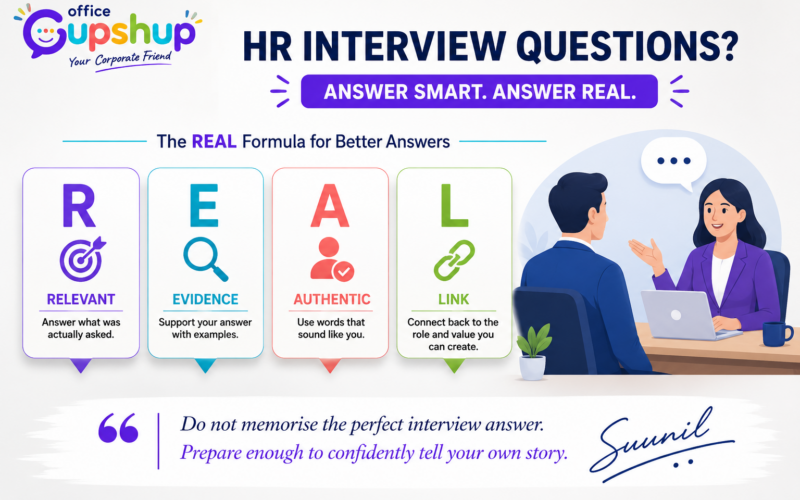
If a networking conversation results in an interview, don’t waste that opportunity by arriving with memorised corporate answers.
Our guide 33 Common HR Interview Questions and Smart, Natural Answers That Do Not Sound Rehearsed explains what interviewers are really trying to understand and how to answer naturally.
Your network may help you get into the room.
Your capability has to take it from there.
Final Office Gupshup Thought
Your skills help you do good work.
Your communication helps people understand your work.
Your reputation helps people trust your work.
Your network helps more people discover your work.
You need all four.
Networking isn’t about knowing powerful people.
It’s about creating genuine professional relationships with people you respect — and being someone they are happy to know too.
So the next time someone tells you:
“Networking bahut important hai.”
Don’t think:
“Kiski chamchagiri karni padegi?”
Think:
“Which genuine professional relationship have I neglected for too long?”
Maybe send that person a message today.
Frequently Asked Questions
Is Networking Important for Career Growth in India?
Yes. Professional relationships can help you gain information, mentorship, introductions, visibility and awareness of opportunities. However, networking should complement strong skills and performance — not replace them.
Is Networking the Same as Office Politics?
No. Networking involves building genuine professional relationships. Office politics generally involves navigating influence, competing interests and organisational power dynamics.
Networking becomes unhealthy when relationships are cultivated purely for political advantage.
How Can an Introvert Network Professionally?
Start with one-to-one conversations, former colleagues, thoughtful LinkedIn interactions and small professional communities.
Networking does not require being highly social or attending every event.
Should I Message Senior Professionals on LinkedIn?
Yes, provided your message is relevant, concise and respectful.
Mention why you are contacting that particular person rather than sending a generic request.
Should I Connect With My Boss’s Boss on LinkedIn?
Yes, particularly if you have interacted professionally through meetings, projects, town halls or other workplace situations. Avoid trying to manufacture closeness purely because the person is senior.
Should I Ask My Network Directly for a Job?
You can, particularly when you have an existing relationship, but specific requests generally work better.
Instead of simply saying “Please find me a job,” explain what roles you’re exploring and ask whether they know of relevant opportunities or people you should speak with.
How Often Should I Stay in Touch With Professional Contacts?
There is no fixed frequency.
The objective isn’t constant communication.
Occasional genuine interactions are better than repeatedly messaging people simply to remain visible.
How Is Networking Different From Chamchagiri?
Networking creates relationships based on mutual professional respect.
Chamchagiri relies on excessive praise or proximity to powerful people for personal advantage.
A simple test is:
Would you still value this relationship if this person’s designation disappeared tomorrow?
Need Help Navigating Your Workplace?
Sometimes the problem isn’t that you don’t know anyone.
It’s that you don’t know how to handle a particular person or situation.
Maybe you’re:
- Struggling with your boss
- Feeling invisible despite doing good work
- Unsure how to approach a senior leader
- Caught in office politics
- Thinking about changing jobs
- Confused about a career decision
- Unsure how to handle a difficult colleague
You don’t always need another motivational video.
Sometimes you just need to discuss the situation with someone who understands corporate life.
Office Gupshup — Your Corporate Friend
Book a FREE 10-minute Gupshup with Suunil.
No lectures. No judgement.
Just an honest, practical conversation about what’s happening at work and how you could approach it.
Because sometimes 10 minutes of Gupshup can give you a completely different perspective.
Office Gupshup provides mentoring and honest conversations about workplace and career matters. Content is intended for general career education and discussion. Individual workplace situations differ, so use your own judgement before acting on any suggestion.